Author: Dan

  • The Cinemax Star Wars Promo

    quick intro: Cinemax will be showing all six Star Wars movies in high definition starting in November. Being that this is the first time all six movies have been shown in HD, they’re making a big deal about it, and have a page setup with various promotional videos. The video in question is entitled, “Original Trilogy.” For lower quality, but faster viewing, watch it on YouTube. The video is also embedded in this page. As will become significant later in this review, the song in the video is Fix You by Coldplay. Note: the audio level is very, very low in this file, so turn your speakers up.

    9 Bulleted Reasons Why This is Probably the Best Star Wars Promo Video Ever (and one reason why I say ‘probably’)

    Turn your speakers up, this is a quiet one.
    • Slow-motion makes everyone a good actor. Star Wars movies (old and new) were never known for their quality of their acting, but in slow motion, these are all Oscar-worthy performances. Notice at 0:41 when Natalie Portman’s character is about to cry: when I saw this in the theatre, there was laughing. And this was the buy-tickets-in-advance very first in the zip code midnight showing of the movie – in other words, people that drink the George Lucas Kool-Aid. But in slow motion… it gets ya.
    • It doesn’t use the all-too familiar Star Wars music for once. We know the “Star Wars opening crawl song”, Darth Vader’s music, and those that truly believe can pick out Yoda’s and Leia’s themes as well as the sort of singles from the prequels. As long as I can remember, Star Wars promos have used this music – it’s common brand recognition, people. But these Cinemax folks, they did something blatantly obvious, yet something that no one had thought of. Just choose the most-overused trailer and commercial band ever, Coldplay!
    • Surprisingly, Coldplay is not a bad choice. I’ve long held that Coldplay is more about the “sound” than the “song.” Of their random recordings and three major albums, they have about five really good songs among an unremarkable but perfectly solid collection of songs. The Cinemax people picked a good one, maybe the best one. Sure, picking this particular song isn’t exactly cutting edge for setting to video, but when was the last time Coldplay was set to non-contemporary images? We see new movie trailers, commercials, wrestling hype videos, and sports highlight packages out the wazoo (it doesn’t seem like people archive these type of videos, so no links), but already familiar images set to the music? — it works because as familiar as Coldplay is, this is a new way to present their style.
    • The video takes advantage of the fact that everyone already knows what happens in the movies to focus on some of the smaller moments. For example: they show the targeting computer footage from the original movie (in slow motion, of course), then Luke is shown reacting immediately after he shoots the torpedoes into the Death Star (using the force as guidance instead of the computer). We all know what he did, what it looked like, and instead of focusing on the destruction, we see the moment of relief when he realized he just really did it. A quick, quiet moment in a movie seemingly lacking nuance like that. Then we see the real big explosion, but we don’t hear the sound effects.
    • Finally, a Star Wars commercial that doesn’t focus on fight scenes and “THEN IT GOES BOOM” moments. It’s nice to see other aspects and moments of the movies highlighted…even if it takes slow motion to make them resonate. (disclaimer: I think I remember some love-ish related commercials to try to get women-folk interested in episodes 2 and 3, but those were as subtle in their appeals for women’s attention as the explosion-heavy commercials went after guys)
    • Again, the scene selection is top quality. The fact that they show Luke coming across the dead bodies of his adoptive parents says a lot about the shot selection. Considering that their death is probably the second most forgotten plot point in all six movies (the first being all of episode 1), and it’s the reason that Luke left his home planet to inadvertently join the Rebellion, it’s nice to see it given proper treatment. And the slow motion certainly helps. Also, instead of showing Luke fighting Vader, or the more famous scene where Vader’s mask is removed, they’ve selected the shot of Luke struggling to drag a dying Darth Vader (Anakin Skywalker at this point, I guess) to his shuttle to save him. This isn’t exactly what a beginner would pick from that sequence.
    • Attention to detail: To movie enthusiasts, the Star Wars movies are known for their attention to detail in sets, sound design, and art direction . The video showcases one of the finer details that’s wholly unnecessary in The Empire Strikes Back, but adds something to the “cold, hard, computers” motif seen on the Imperial warships. At 1:28, we see Darth Vader kneel down as he is about to begin his long-distance conversation with the Emperor (who, I’ll point out, is not seen at all in this video, prequels or original movies). It’s a significant moment in the original movies because, after seeing Darth Vader as the ultimate bad guy in the first movie, he’s shown bowing down to someone who really must be bad (as you can imagine, there’s more significance there if you’ve never seen the prequels). This plot point actually isn’t the detail in question though; it’s the fact that the set designer chose to progressively illuminate a four-segment ring of light on Vader’s platform after he knelt down. All of this a considerable amount of work for the carpenters what with the fact that the lit platform was shown in all of two shots. Now, whether the people that worked on this video read that much into it, I don’t know, but at the minimum, it’s an interesting shot from one of the less prominent sequences in any of the movies.
    • It makes the prequels look like movies that mesh with the originals. The fact that the old and new movies have almost completely different “looks” has been beaten to death, but the video merges the two styles into one organic universe (as it’s supposed to be between the trilogies). The Millennium Falcon taking off from the original movie followed by a ship from the prequels doing the same provides a connection to the big picture similarities between the movies. (Yes, I know the Millennium Falcon shot was from the Special Edition, but I’ve never heard of anyone complaining about that replacement.) Shots from the prequels are sparse, but well selected; there’s nothing there to remind you of the bad parts.
    • The music of the song really matches the video well [note: I’m talking about the music, not the lyrics (see below)]. To be honest, this isn’t a challenging song to mesh with images; it starts slow and simply with vocals and an organ, then builds as layers are added to the soundscape with guitars, bass, drums, echo, reverb and other studio magic. The key is that the song has energy, even with a slow vocal part. Simply, good trailer music is too slow to regular dance to, and too fast to slow dance to. Like many Coldplay songs, this sits at that neither-here-nor-there perfect-for-trailers tempo.
    • The lyrics are matched to shot selection too well. Someone at Cinemax said, “wouldn’t it be cute if when the lyrics say ‘I will fix you’, we show Chewbacca fixing C-3PO?” Unfortunately, no one said, “it would be, but that’s a stupid idea.” Though not exactly a metaphorical song, the lyrics can safely be called “evocative,” especially the “lights will guide you home” part. Pairing “when you try your best, but you don’t succeed” with Luke failing to lift his ship out of the swamp, again, is cute, but is ultimately an annoying choice. I’m not believer in the “power of lyrics,” but matching a video of someone trying and failing so literally with that phrase implies that the song is about a specific time when someone tried and failed, and without any sense of generality, that little phrase loses any poetic meaning. It would be like if a greeting card company began printing cards that said, “You’ll be my best friend until the end of time” because a gigantic meteor was on its way towards Earth in one week with a 100% chance of total destruction. The phrase loses any rhetorical weight it might have had because it’s addressing a very literal situation [I’ll pause here to let that one sink in…]. This also goes for “stuck in reverse” while showing R2-D2 rolling away with his back to the camera. BUT, the shot of Obi-Wan smiling (in slow motion) when he’s decided to sacrifice himself to Vader to allow Luke to escape during the first “lights will guide you home” line (1:07) works perfectly, as does the focus on the targeting computer as the song reaches that point a second time (2:09). *Special gross comment: Being that the song does include the “and ignite your bones” lyric, I’ll say that with the movies offering three four different instances of burned bones (the Owen and Beru Lars invitation-only BBQ of the original movie, Anakin totally forgetting that Obi-Wan had the high ground in Episode 3, and Luke getting his hand ginsu’d off in The Empire Strikes Back and Vader Flambee at the end of Return of the Jedi)), I’m surprised they didn’t have thrown a few frames of those shots in the video at the (overly) appropriate times.

    *****
    Too literal video to lyrics issues aside, this is the video which shows why people like these movies. Coincidentally, there’s no dialog, but there’s also very little action; it’s the characters and how they deal with their sneakers-too-large-for-their-feet problems and come out on top that pulls the people in, it’s the effortless attention to detail, it’s the entirely unreal yet very real world and characters created in the movies. Enough of my soapbox. It’s also really cool when the video shows the starfighter from the prequels (2:04) breaking off to blow stuff up, then immediately follows it with the point-of-view shot of the Luke entering the trench of the first Death Star with that same organic, rolling motion. Highest recommendation.

  • The Human Back (Model Year 1982)

    (Ripping off of 1/3 of Adam’s title from last fall)

    The MD: Tell me about the pain in your back.
    Me: Well, I can stand up and lie on my back just fine.
    The MD: Okay, good.
    Me: But everything other than that feels like the end of the world.
    The MD: (In the way a doctor would react to a 3 year-old with an “ouchie”) Oh, that’s not good at all.
    Me: Yeah.

    A bit less than a year ago, I wrote a little review about getting older, specifically some unrelenting shoulder pain. Well, that was just the tip of iceberg compared to this one. (And all things considered, it hurts so much that it’s not really a laughing matter at this point). Doing nothing stupid, out of the ordinary, or what I’ve not done lots of time before, I managed to make myself bedridden by the simple act of bringing my groceries inside. The only significance of the problem-causing event was that it could be construed as if I had made an awkward motion and tore a muscle at the small of my back. (the ‘could-be-construed as’ part being the awkward motion, not the torn muscle).

    back

    You choose the caption: 1) Not exactly bringing sexy back. 2) Hehe, you said T12.

    An awkward motion… the red-headed step child of reasons for (relatively) serious injuries. Similar to last year’s much less serious pain, the type of thing that only happens to the rapidly aging and rapidly aged. Not to steal Adam’s joke completely, but I’ve expected much more from my back than going out in such a girly way. (for those that say, but you were born in November, wouldn’t that be the beginning of model year 1983? Not this guy; it’s becoming more and more obvious that I was old stock, made from parts whose lifespans were already one year short due to sitting on the lot for so long. Sure, my back has serviced me well so far, but with my life expectancy being somewhere around 77 bitter years, it’s awfully early for the frame to have gone bad (one of the axles is already shot).

    But man, it hurts. I’m normally a big fan of the small of the back; it’s just so …. useful. But not now. It feel like it’s where North Korea did yesterday’s bomb testing. (how’s that for a needlessly topical joke). Oh it smarts real good.

    *½

    The Human Back (Model Year 1982) receives one-and-a-half stars due to its not even lasting half of an expected lifetime before (relatively) serious failure. (No, I’m not being dramatic: being unable to go to work or even do anything other than lie down or stand up shows that the body part has failed, at least temporarily. If someone were unable to attain consciousness, the brain is considered to have failed.) The meager 1.5 stars come from the sort of trouble-free past years of use.

  • Other People Stealing Your Ideas Without Ever Having Met You or Knowing that They Stole Something Part 2

    Mini-Review (no exclamation mark)

    Yet one more instance of the Bookshelf® being a step ahead of the mass media.

    Last week, the latest “internet phenomenon movie,” 300 released its first official trailer. Without judging the movie, of which I only know a marginal amount, it looks like someone decided to make a bluescreen movie, but this time, turn up the dynamic range.

    300
    Just imagine how mad he’d be if someone unknowingly stole his idea…Without asking!

    Anyway, take a look at the trailer here, and give it a nice listen. Yep, the music might sound a bit familiar for those of you that remember a semi-but-now-quickly-being-un-disowned movie trailer put together by your favorite group of (not so) local idiots. That’s “Just Like You Imagined” from Nine Inch Nails’ album, The Fragile. These “300” people stole my idea without even having met me or knowing that they stole something.

    *

    They get one star because they’re movie looks pretty darn cool, but they lose four because of the aforementioned idea-stealing, and the fact that they didn’t take advantage of the fact that the song already has the “quiet, loud, quiet” dynamic good for making movie trailers dramatic (or in our case, confusing) and just recycled the beginning of the song at the end. Bad form, Hollywood. Bad form.

    *to be fair, the song was used in a trailer before we used it, but it was a trailer for a Nine Inch Nails concert DVD, so I think it’s safe to say that that doesn’t count. I’d send a link to that video, but it’s buried within the Flash in the “clips and trailers” section of the DVD’s website.

  • The Current Gas Prices

    Lest The Bookshelf® return to its former rant-happy ways, here’s one with some general positivity.

    What with gas prices getting higher than friend of The Bookshelf® and noted ginger ale enthusiast J Calloway at a ginger ale festival, it looks like we’re back to more reasonable numbers on the boards. The $2.399 low price in the good old 19063 is enough for me say, “hey, gas prices aren’t awful anymore.”

    gas
    The last time the Oil Industry Puts 14 Year Old Girls in Charge of Anything.

    Um, there really isn’t much more to it than that. I’m just spreading the positive word. Well, actually, I guess that being that I’m able to remember the days (well, I think it was a couple of months) that gas actually less than $1 when I was 14 or so, but after dealing with it around $3, the current price seems A-ok. Me=Consumer Whore.

    ****

    The Current Gas Prices receive four stars due to the fact that people are quick to complain about how much it costs when the price is high but forget to appreciate the moments when its back to more sane levels.

    unniversary
  • Once Again Being One Up on the Mass Media Or The Critical Reception to Jackass: Number Two

    It’s well known that aside from some misinformed old-cootedness about video games, we hold Roger Ebert in pretty high esteem around these parts. His cancer-surgery-turned-surgical-complications has taken him out of the reviewing game since mid-summer, and though no announcements have been made, I’m guessing he won’t be back until “Oscar season” starts in mid-November. Regardless, I’ve taken issue with very few of his reviews, though his “thing” for Angelina Jolie’s lips awarded both of the Tomb Raider movies three undeserved stars, even looking at those movies in the “brainless action” genre. That tick of his aside (a soft spot for threatening-looking women), the only other time I’ve not taken his side was when he decided the original Jackass wasn’t worth reviewing. Unfortunately, I can’t find the actual article that includes the quote that I think I remember, but it went something like this (notice the single-quotes – journalistic integrity is listed as a category for this review) ‘I am a movie critic. I review movies. As funny as Jackass is, it’s not a movie.’ In short(er), just being a collection of skits, none of which tells any sort of traditional story, it’s more accurately a “video” as opposed to a movie. I couldn’t find that quote, but I could find him answering a reader’s question about why he didn’t review it. In an interview with Charlie Rose, Ebert said, “If I laugh, I have to tell you it’s funny. I went to see ‘Jackass,’ a shameful movie. I laughed all the way through it. I mean, I have to tell you that.” At the end of day, instead of giving Jackass a positive review (what with it being a successful movie, one where the audience is entertained) and being on the record as having condoned something like that, he chose to not review it at all.

    jackass
    I don’t get it.

    Now, speaking as a principled person myself, I perfectly recognize the need to occasionally throw all principles out the window if there are extenuating circumstances. Ebert simply didn’t want to be someone associated with a movie like Jackass. Luckily, his on-screen partner in reviewing all things cinematical, Richard Roeper gave probably the best critical quote about it: “Jackass: The Movie is a disgusting, repulsive, grotesque spectacle, but it’s also hilarious and provocative. God help me, thumbs up.” Hallelujah. That’s even more positive than my review would’ve been. (for the record, having seen both of the movies, I’d say that I could do without the poop and the pain for the sake of pain stunts)

    I’m not one to find profundity for the sake of profundity, but my stance on the movies is this: they’re not profound, but there’s something to be said about the sociological aspects of what a bunch of suburban-ish white guys found to entertain themselves and the business acumen it took to make what they were doing marketable outside of the skater community.

    The issue I do take with Ebert’s (lack of a) stance is that his book of “The Great Movies” (quotes because that’s the actual title of the book) includes the 1929 short film, Un Chien Andalou, notable for its lack of coherent structure and (more so) co-creation by one Salvador Dalí. I won’t compare work by Salvador Dalí to the content of Jackass, nor will I insinuate that Jackass somehow deserves to among “the great movies,” but I will say that for someone who is very quick to condemn the supposedly increasing closed-mindedness of the American movie going public, not giving a movie you liked the critical time of day because it was “different” isn’t the strongest philosophical ground to be standing upon. (I know, it’s sort of lazy of me to not include links to examples of “very quick to condemn…” but, in short, look up any of his Adam Sandler reviews other than Punch Drunk Love.)

    The loose thread between the “Once Again Being One Up on the Mass Media…” and the movie itself is the fact that in the AP review, the writer actually invokes a comparison between Jackass: Number 2 a scene from Un Chien Andalou. There’s not much more to it than the fact that I said the same thing in 2002. And, I was reasonable enough to give the comparison with a bunch of qualifiers instead of trying for some sort of faux-intellectual comment.

    ****½

    Once Again Being One Up on the Mass Media Or The Critical Reception to Jackass: Number Two receives four-and-a-half stars due to my thinkin’ brain and its whooping of the critics by four good years. In actuality, the whole mess with Ebert’s take on the first movie is sort of unrelated to this, but it does serve as backstory as to why I had done any thinking on the subject. If you’re thinking about seeing the movie, it’s as simple as this: if you think you’ll like it, you will. If you think you won’t like it, you won’t. If you’re not sure if you’ll like it, you’ll like it.

    Late-breaking, sort of related reviewing: Jim Emerson, the sort of backup on rogerebert.com has his own blog (aside from the corner he gets on the Ebert webpage). On his blog, he has a cute little entry entitled, “Aint-It-Cool-Times” (his emphasis) bemoaning the Los Angeles Times for including a script review section on their website. He’s so put off by it that he says the newspaper has “jumped the shark” (and I thought Emerson was a movie critic! buh-ZING!), becoming yet another head of the hydra that is the modern movie industry (my metaphor, thank you very much). There’s a bunch of resentment of the “traditional” journalists (print, TV, radio) towards the “new” “journalists” on the internet. Sure, any schmuck can run a website and spout off whatever nonsense he wants and claim to be a journalist (note: Nate and I don’t claim to be journalists. Adam? Maybe.) What with journalism degrees being real degrees, the “old guard” doesn’t like the instant credibility that the internet offers. Aintitcoolnews, the target of his sort-of pun of a title is one of the more successful “home made” websites, and in fact, in the years it’s existed, it’s sort of a “real” site, though it does seemingly serve as a mouthpiece for the studios marketing departments sometimes.

    He goes on: “No. It’s not. Fernandez [the writer of the script review section of the Los Angeles Times] isn’t a journalist and he isn’t a critic [and this just became a run-on sentence]; he’s a leech, on the level of those self-aggrandizing amateur web trolls who think their premature, uninformed opinions about an unfinished work are ‘news.’” Amateur web trolls? eh. Premature, uninformed opinions? meh. Self-aggrandizing? MR. EMERSON, YOU HAD ME AT ‘HELLO!’ We here at the Bookshelf® … wait, hold on, I like seeing that with the registered mark after it…. wait….yeah. We think you’re wrong and are probably just bitter that you had zero web recognizability until you became Roger Ebert’s second-in-command. Consider yourself called out by the Bookshelf® (you join such luminaries as the New York Times, Humanity, that horse, and Pitchfork Media).

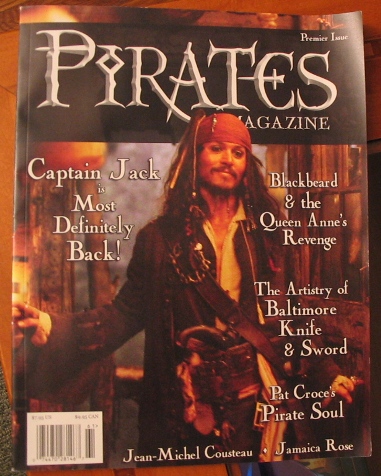
  • Pirates Magazine Premier Issue – The Cover

    The first in what might be a series of reviews.

    I was at the bookstore the other day, more-or-less stocking up for what ended up being a fictional trip to China, and after picking out a selection of books, I wandered over to the magazine section of Borders. The goal of magazines at a newsstand-type setting is to catch customers’ eyes, so they completely overspend and make an impulse purchase instead of saving oodles of money with a subscription. My eyes wandered across the fast cars, the cleavage, and the heroic-looking sports poses, and I stumbled across the word “Pirates” in a large, offensive typeface. Next to it, in smaller type, “Magazine.” YES! Whether it was a magazine for pirates or pirate enthusiasts, I plopped down my $7.95 (minus 2 stars right there), and put on my ridiculin’ hat.

    Some communities should just stay on the internet. I’ve never been a fan of people taking things I don’t care about too seriously. I could make some sort of list here of examples, but at the end of the day, let’s just admit that the list would contain pretty much anything you could think of, and the real challenge would be in the taxonomy of it all (grouping Hershey’s Chocolate Enthusiasts with people who love Mike and Ike because of the whole candy thing). In the “hobbies I don’t respect” category, we’d find the Renaissance Fair fans, people that dress like comic book characters, movie characters, Star Wars characters, and so on. Though these people bother me in concept, for the most part, they’re off in their own corner of the internet, arguing about whether Qui-Gon Jinn could beat Saruman, then dressing up and living out the fight and getting out of breath, so hey to each his (or, rarely in this case, her) own. So, when “they” crossed over from internet phenomenon into a group seemingly legitimate interests, I did not like it one bit.

    pirates1

    Obviously this magazine was created to capitalize on summer 2006’s second biggest movie, X3.

    So, what exactly does one put in a what will (in theory) end up being a quarterly magazine? Well, judging by the cover alone, not buxom wenches, some pirate history (Blackbeard & the Queen Anne’s Revenge), pirates in pop culture (Pirates of the Caribbean), profiles of people bringing “pirate” back (Pat Croce), the details of the construction of the ill-advised Christmas gifts that people’s grandmother’s buy on QVC (The Artistry of Baltimore Knife & Sword), as well as treasure hunting (Jean-Michel Cousteau), and other piratey sounding things (Jamaica Rose, whatever that is). All-in-all a good mix for the overly enthusiastic, but at a rather full 88 pages, they’re going to struggling for content after, I don’t know, issue #1. The Bookshelf’s experience with the printed word proved two things 1) we can do anything we set our mind to do, and more seriously 2) one issue is easy – two, not so much.

    In all honesty, people that collect such things probably love to know the detailed process that goes into making collectable swords and knives, and again, there are probably people out there interested in doing something as close-to-pirate-like-as-possible such as a real-life treasure hunt, but really, you’d think that advertisers would realize that addressing the potential customer with “You be wantin’ to be a pirate?” or things like that might get old after, I don’t know, five pages.

    **

    Pirates Magazine Premier Issue – The Cover receives two stars due to the fact that even though I have no respect for their hobby, it seems to address things that I’d be interested in if I were a pirate enthusiast. The title isn’t so hot, though it doesn’t lead the customer guessing the contents of what he has in his hand. I’ve yet to really delve into the magazine, but so far, in terms of its art design, it’s somewhere between “professional” and “Look at all these buttons in InDesign!” There’s enough Times New Roman to kill a, um, giant sea-faring enemy of a pirate and some of the ads look like something from my high school year book, but there is something to be said about what might be called its “rustic” charm, and the authors do a reasonably good job avoiding easy pirate jokes. But, paging through, I can’t help but notice items in the magazine geared towards “re-enactors.” That’s really the bottom of the barrel in terms of “geekdom” — see the left side of this chart. A special note about this chart: It was made by that Lore guy who beat us to the whole “reviewing anything” schtick, and we’re still bitter about it, especially considering the quality and accuracy of the chart.
    Anyway, judging the magazine by its cover alone, it gets those two stars (two stars off for the only-for-enthusiasts pricing and one star for the whole ‘promoting things that really shouldn’t be promoted’ thing). It really reminds me of “Chew” magazine from Calvin & Hobbes, with Calvin enthusiastically reading the whole issue very seriously while Hobbes just didn’t get it. (Bill Watterson probably meant it as some not-too-subtle jab at crass consumerism, and that was even before the internet catered to even “nicher” interests).

    I’ll leave with this: I’m not particularly interested in anything, and I’d never pay $8 or even $10 for an imported British car magazine. Twice. I also live in a glass house.

  • Thinking of What’s Probably the Best Possible Thing to Put in a Going Away Card Ever

    I don’t mean to pat myself on the back….well, okay….yes I do. Someone I know who is from Switzerland (the French-speaking part, for whatever that’s worth) and spent the last few years living in the US is moving back to Switzerland very shortly. A blank-on-the-inside going away card was passed around, and it was obvious that most people thought about what to write for about 30 seconds then decided on, “Good Luck! We’ll miss you!” No problem, it’s not like they didn’t mean it. But not this guy. I gave it 15 seconds of thought, and inscribed this gem of pure wit: “…and I thought it was a New Jersey accent!” This ranks right up there with Nate’s Christmas card message about people leaving their dogs outside to freeze during Christmas. Incredibly proud of myself, I thought to sign my name to my masterpiece and pass on the increasingly valuable card, except I realized that maybe I didn’t want the recipient thinking I was all funny and not enough serious, so I stamped a “Good Luck! We’ll miss you!” at the end.

    Best. Going-Away-Message. Ever.

    card
    I see your “BLANK” and raise it…hmm….awesome hundred dollars.

    *****

    (See, she’s from Switzerland and has a very obvious French accent …. eh, never mind.)

  • The Unfair Critical Treatment of Former Boy Band Members

    Let’s see if I can get out some reviews for once…

    I’m not being profound when I say that success is a great way to turn the less successful against you. In the burgeoning field of critical criticism, this fact is no more obvious than with music critics. Movie critics are relatively high profile (notably Roger Ebert), and there is a variety of widely known names in the field (Gene Shallit, Peter Travers, Leonard Maltin, etc.) and almost never write “I could make a better movie than this, I’m just choosing not to” types of reviews. If anything, for a really awful movie, they’ll just say, “Anyone can’t write (successful) music, but think that they can. This isn’t where every music critic comes from, but it’s a heckuva lot easier to say, “I’m going to tour the country, and sell my CDs to all the free-thinking Zydeco-Blues-Jamband-Trip Hop-New Wave-fans out there” and think you really have a chance than saying “I’m going to be a movie star,” and actually believing your own hype.

    But the weird thing is that with music (well, like movies, too), one doesn’t necessarily need to be particularly talented to get really far with a career in it, for some amount of time, at least. Obviously, the poppy-est of pop music is the ultimate example of this. We’re sort of in a dry spell for “bubblegum” pop at the moment, but it’ll come back…it always does. NSYNC sold (capital “M”) Millions of records, made lots of money, achieved a huge amount of fame, and those people with musical dreams in the previous paragraph? Not so much. See the part above about success and the unsuccessful.

    band
    In Soviet Russia, band boys you!

    See, I have nothing against NSYNC (or any of those groups). First (and what should be the most obvious), I’m not and I never was their target market. It’s not my money spent on their CDs, merchandise, etc. If I’m that offended by their existence, I can change the channel, the radio station, whatever implement of the mass media on which I’d see them. And second, in interviews, they seemed like perfectly friendly guys who had a lot of fun and realized they were really a product of the current time, and they’d be “done” when they needed to be “done.” (to be fair to the “haters,” the Backstreet Boys didn’t seem to have quite as much perspective/insight into their fleetingness). Second-and-a-half-ly, there’s something to be said for making somewhat listenable music that gets played on Top 40 radio: I can’t stand most of their catalog, but “Bye, bye, bye” is a darn good song, you’re just afraid to admit it.

    And third (where the music critic thing comes in), no matter how “unmusical” they might’ve been, it really doesn’t matter. Someone would laugh out loud if anyone in NSYNC said he was “living his dream of being a musician,” but if he said, “I’m living my dream of being famous,” well, you really can’t argue with that. Toward the end of their popularity, you could tell that their “handlers” thought they could gain more fans if they were involved (in some nebulous capacity) in the writing of their music (as opposed just the performance of it), but the writing was already on the wall for their genre of “pop” as “real” signer-songwriters like Avril Leveigne took the torch and were equally not the type of music someone like me would in the market for.

    But did these boy band members have any talent? Easy answer: of course not, they sold millions of records because of the people pulling their strings. Not-so-easy answer: they sold millions of more than one record, and no matter how smart the people behind the scenes were, there were five guys that needed to keep a rather limited “schtick” interesting.

    Justin Timberlake, undoubtedly the most musically successful of the former members, gets the worst rap. He was probably the most popular among the ladies during his days with NSYNC and let’s not forget his white-boy-fro: plenty of reasons to hate the guy. Basically, he managed to turn a boy band career into a “leading man in music” type of trajectory with one CD, and his upcoming CD will cement his role even further. Of course, he won’t be able to shake the “boy band” thing, but there’s something to be said for people always being interested in your next CD, if only so they can complain about it loudly, inadvertently helping to promote it.

    Which brings us to the actual center of this review, a seemingly innocuous review of one of the new singles on Justin Timberlake’s new CD. Once again, let me call out pitchfork media. Now, I’ve not heard the song in question, but the review of “My Love” is the issue. But wait, you say, “Dan, but the review got five out of five stars, and pitchfork media doesn’t like anything.” I say, “Look more closely.” Sure, it got five big stars, but look to see why. It certainly doesn’t have much to do with Justin Timberlake according to the writer. Timbaland produced the song, which as we know, in hip-hop means he did either a whole lot or a whole little. It would appear that Timbaland, for this song, did “a whole lot.” In fact, according to the review, it’d look like he did the whole darn thing. As if there’s no way that someone who was, *gasp* in a boy band (much less one of the most successful ever) could accomplish anything after that on his own merits after this. Stereotyping and generalizing all people bitter at boy bands’ success to be like pitchfork media, it’s weird that they’d be so invested in seeing him fail, and if no one heeds their (the holier-than-thou’s) warnings, then they need to explain away how the guy got successful (Timbaland supposedly writing the perfect song, etc. without any help from a former boy bander). I’m still not the target market for Justin Timberlake’s music, but that doesn’t mean he deserves to fail.

    **

    The Unfair Critical Treatment of Former Boy Band Members gets two stars due to the fact that it seems like some people just can’t get past the fact that someone who became successful doing something unfathomable to them (doing a good job lipsynching while dancing, mainly) could go on to something larger and somehow respectable outside of the realm of middle-school girls. Like I said, a lack of success breeds a bitterness towards the successful. The two stars come from the fact that there is plenty of insignificant music churned out by former boy band members that even I (who’s half taking the role of Devil’s Advocate in this) couldn’t defend.

  • Navel Gazing Part 2: Sneakers as Temporal Landmarks

    Now that is a triple-word-score $5 title!(all ridiculousness aside, stick with me, I’ll explain what I mean by that later. I really couldn’t think of a more condensed name for the concept.)

    Those that know me and read the website (I’d wager the two are almost mutually exclusive — except for the ragtag bunch of misfits that Nate drags in) know that my Youth was marked by complete, abnormal interest in a variety of subjects. I’m not sure of the exact order, but it went something like this: dinosaurs, space, birds, Star Wars, airliners, fighter jets, and what I’ve sort of landed on now, computers and cars. That’s all well and good as it could be, and until very recently (yesterday, to be exact), I thought these phases were the be all and end all of “where I was” at a particular time, the landmarks (or buoys) on to which everything in my past had been tied. As in, when I’d page through my old, binding-suffering-because-of-overuse copy of Audubon’s Field Guide to North American Birds (1994 edition, of course), I’d remember X, Y, Z that happened around that time. Same thing when looking through my old space books, the binders I put together about airplanes, my dinosaur toys, etc, etc. I had thought that those were it for “way back when.” I think the reason for thinking in these terms is that each stage stands alone as a very discrete point in time. I can’t put my finger on exactly when I was interested in airplanes, but it was after such-and-such and before other such-and-such. Obviously, this isn’t how life goes, it’s rare for there to be a finite and complete “end” to something. Sure, I still remember bits and pieces from each “stage,” but I’m not usually adding more to whatever it is that I know and remember about each. I hadn’t put much thought to it, but these academic pursuits really only have memories about the particular subject associated with them: sitting in the cold, convincing myself that I was always just one more roll of film away from taking a picture good enough for Birder’s World with my crappy camera, and on and on. That’s the sort of thing I remember when I look through my old bird books. That’s all well and good, but as I’m looking at it now, I must not have been a very interesting kid, only remembering things related to these rather niche interests. So that leads us into yesterday.

    aj12
    Oh, the memories. Sort of.

    I have a bit of a soft spot for sneakers; my Oakley Twitch review might’ve shown that, but being that I limit my purchases to the shoe in question, it’s quite under control. Recently, the Nike Free 5.0‘s have intrigued me. I have one pair of what I’ll call not-sitting-around sneakers, so I definitely don’t need these new sneakers, but I think they look nifty, and having tried them on, they’re very comfortable in their own, unique way (just like Nike would have you believe). So, this sneaker-centric internet browsing led to a corner of the internet I knew existed but didn’t realize quite how serious they were. The sneakerheads/shoeheads. All things considered, that’s fine. There’s no better place than the internet to complain about how “Nike’s reissue strategy really screws over the collectors because they claim a colorway will be limited, then change the packaging and sell it to everyone.” God bless the internet. Anyway. All this led me to this exact page, a history of all the Air Jordans. At first, there’s little significance there, I’ve never owned a pair of Air Jordans, they were way out of what my mom decided my sneaker price range was and by the time I was buying sneakers myself, they were still way too expensive, and more importantly, I wasn’t really into basketball sneakers anymore. But where this comes together is how big a deal sneakers were for elementary and middle school boys (that’s not a universal thing, but consider it a blanket statement). Looking through the list of Air Jordan’s, the first ones I remember as being “the new ones” were the Air Jordan 5’s, released in 1990. I was 8, but I can remember who the first person I knew that had them and how much I wanted them. I remember seeing the kids wear them for intramural basketball games at the East Side Youth Center, and on and on. And these aren’t people or things I’ve even thought of since then, way back in 1990. Oddly enough, going through the rest of the Air Jordan’s up until 1996’s Air Jordan 12. I had no intention of purchasing a pair then or now, but I remember talking about the new colors that would come out every month or so with my more athletic-minded friends at the time, many people I hadn’t thought about since then (until randomly looking at pictures of sneakers online), and oddly enough, the first time I really thought about the interior details of my middle school, something I thought I had forgotten since the day of my 8th grade “graduation.”

    It goes on and on, looking at any of the high profile sneakers from 1990-1997, lots of stuff I didn’t realize I remembered. But it ends there in 1996/1997. Sneakers after that don’t elicit anything. I thought about it for a while, and I realized why. That’s when simple things like sneakers were phased out by a more serious interest in music. Like anyone “young,” I had always enjoyed TV, movies, and Top 40 radio, but around 1996/1997 (14 or so years old) most everyone has had a couple serious years acquiring his or her own personal taste in music. Before that point, oddly enough, sneakers provide those “temporal landmarks,” but after that time, it’s really music that reminds me in that same way. Of course it’s not just music, there are all sorts of “touch points for memories:” textures, smells/scents, pretty much anything, even the way a Chevrolet Lumina’s steering wheel feels. But none of this is news to anyone, we’re all simply interested in different things at different times in our lives. I had sneakers, but I’m sure other guys (and girls) have video game “sponsored” memories (I have some of those, mainly from being at friends’ houses, what with my mom associating video games with some sort of figurative devil) or memories when you find a Goosebumps book in the basement of your house.

    ***½

    Navel Gazing Part 2: Sneakers as Temporal Landmarks receives three-and-a-half stars due to its main point’s obviousness as the review went on. The hyper-ambitious title perhaps hinted at possibilities left unanswered and avenues unexplored. Also, I’m a firm believer in sneakers being the ultimate artifact of contemporary design for point in time (heck, look at that Air Jordan overview, and see how the shoes from the early 90’s, with their neon colors, which were the new hotness™ way back when — my goal for the too many pairs of Oakley shoes I have is that they’ll be a bit more long-lasting in terms of style), and I’ve not touched on that concept one bit above.

  • Navel Gazing Part 1: A History of Violence

    Once again, the generous sponsorship of the Fruit Stand/DVD store made this review possible. Be sure to stop by and enjoy a 50% discount if you’re not American!

    I’ve said I don’t enjoy writing movie reviews, so I’ll try to skirt around specifically “reviewing” the movie in that exact term, but it’ll be tough considering the movie is intertwined with its message.

    Usually when someone goes out of his or her way to create something “deep,” “thought-provoking,” “challenging” or the like, the final product doesn’t end up being any of those things, if only because if it draws too much attention that goal (“deepness”) instead of the movie itself. It’s incestuous, but I’ll link here to my review of Inside Man with my brief commentary on its very out-of-continuity “thought-provoking” scene of the seemingly vicious bank robber being disgusted by a Grand Theft Auto-look-alike. A History of Violence practically begs for over-analysis starting with its vague but simultaneously pointed title. The director, David Cronenberg, is very much on the record talking about the philosophical issues raised by his movie.

    I Violenced Your History!
    All That You Can’t Leave Behind. (bonus points for invoking a U2 song in a faux-deep manner!)

    Most “deep” movies become grossly over-analyzed, with the arguers forgetting what the movie was about and what happened in it (or what the movie wasn’t about and what didn’t happen it””Donnie Darko fans, I’m looking in your direction). Throw in some psycho-babble (“Munich was about how Israel became self-actualized in the 1970’s and 80’s”), and you’re good to go. Without putting it terms of whether it was a good movie or not, Munich certainly had enough going on it to not need this over-analysis. (Okay, to be fair, some people have complained that not much of anything happened in the movie, other than Eric Bana sweating like a maniac when he was getting his pump on.) Oddly enough, “A History of Violence” needs this discussion; not a whole lot happens in the movie; it could basically be considered an immediate and direct sequel to Goodfellas. (I liked A History of Violence enough that I won’t ruin the “how” and “why” that lingers throughout the story for our readership, but if you’ve seen Goodfellas, you’ll understand what I mean about it being the next step in the Goodfellas story.)

    Sure, plenty happens in A History of Violence, but the characters spend so little time onscreen reflecting on it; the extent is really “how long have you lied to me? And did I marry your past or just an identity you arbitrarily created?” The viewers are in the same position as the characters after the open-ended conclusion of the movie. Like the characters, the viewers are asking themselves, “What’s in me? What am I capable of if something needed to be done?” “Would I be able to leave behind my “