Author: Dan

  • Keasbey Nights, Vol. 2 by Streetlight Manifesto

    At this point, I’ve realized that the readership is very selective in terms of what it considers interesting enough about which to read an entire review. Being that Nate’s and my interests, though not identical, can be said to not be all that enthralling to whatever we’d consider the readership-at-large, and this is another one of those reviews that is more-than-likely out of the realm of interest for most of you, feel free to suggest future topics as you gloss over this one.

    My short list of best albums ever is very short. #3 tends to vary depending on any number of factors, #2 is always “Wish You Were Here” by Pink Floyd, and #1 has been “Keasbey Nights” by Catch 22 since the first time I heard it in 1998. I’d evangelize for it (if that’s a correct usage of that word), but it’s music that is only appealing those that already like that type of music. This part will sound like every other description/write-up of the album in 1998, but it combined punk, ska, and hardcore elements in a way that didn’t simply add a ska-inspired brass section to a punk band (Less Than Jake, I like you, but I’m looking in your direction) or a lead singer who alternated between hardcore yelling and regular singing so he could, you know, “show that he had a sensitive side.” I’m not one to get much out of the simple fact that people in band are (or aren’t) skilled musicians, if I were, I’d be a Rush fan, but most write-ups of Catch 22’s album in 1998 mention the “chops” of the brass section.

    vol2
    Bitter much? I think the “volume 2” part is just used so retailers can more easily keep track of the two albums of the same name and same songs.

    Though a hugely popular album, “Keasbey Nights [1998]” is part of a genre where popularity is usually measured on one or two scales of magnitude down from “pop” popular music. Pretty much any fan of non-MTV punk music and what people with too much time on their hands call the 3rd Wave [of] Ska has heard of the album; they might not all consider it the best album ever, but it is generally held in universally very high regard.

    In briefest terms, “Keasbey Nights, Vol.2” is a 2006 released re-recording of that same album that came out in 1998 by a different band (Streetlight Manifesto) that includes some of the original members of Catch 22, notably the original lead singer who was also the one who was the songwriter for the whole thing. Oh yeah, he also left Catch 22 less than one year after Keasbey Nights came out. More so, he’s the founder of Streetlight Manifesto. Not to turn this into story time, but we see how there is a lot more to this, um, “re-album” than you might expect…

    Like I said earlier, the album was popular among a very limited group of people, but if anything, that group is rather passionate. If you look around the internet, you’ll see numerous “stories” about why that lead singer/songwriter, Tomas Kalnoky, left Catch 22, and not to contribute to “the internet,” but I think I remember hearing an audio interview with him where he said that he left to go to college and touring definitely wasn’t conducive to that. A fair number of websites say that there was a dispute between him and the record company, though I’m not sure why he’d choose to distribute his new band’s CDs through that same label though. To be honest, the reason he left doesn’t matter to anyone but him and 1998 Catch 22 (like a lot of 5+ person bands, they’ve shuffled their lineup a bit, just like Streetlight Manifesto). But, to contribute to “the internet,” let’s assume that the mystery situation that made it so he felt compelled to re-record and re-release a CD from 8 years ago, let’s unsafely jump to some unfair conclusions that, being that we’re decidedly removed from the actual people involved (and it’s not our business), will attempt to explain why.

    No matter the talents of the original members of Catch 22, the strength of the album came from Kalnoky’s songwriting. Catch 22’s follow-up album, “Alone in a Crowd,” was mediocre at best. To be fair, their most recent album, “Dinosaur Sounds,” is perfectly acceptable, as it seems they got comfortable writing songs that weren’t trying to sound like ones that Kalnoky would have written. Kalnoky’s leaving relatively soon after the release of Keasbey Nights created a number of problems:

    1. The other guys in Catch 22 were aware of the success of the album (for a time, it was Victory Records’ all-time highest selling album, and Victory is not an insignificant record label in the punk/hardcore world). When the reason for their success (Kalnoky) left for whatever reason, they were probably pretty miffed at him as he was almost singularly responsible for their success. So, that’s the band being mad at the all-of-a-sudden checked-out lead singer and songwriter.
    2. Instead of calling it quits or re-organizing under a different name, Catch 22 shuffled the lineup and continued being a band whose drawing power was defined by someone no longer affiliated with the band in any way. Not that Kalnoky considered Catch 22 his baby, but Catch 22’s livelihood stemmed from his songs. Not to judge anyone’s moral character, but he would have been crossing a long asking them to break up the band when he quit, while they would have been crossing a line if they would’ve said he would’ve been being unreasonable had he asked for that. Again, who knows what happened, but it ties into the release of “Keasbey Nights, Vol. 2.” So, that makes the checked-out lead singer and songwriter miffed at his former (by his choice) band.
    3. At two Catch 22 concerts I attended in 2003 and 2004, the audience had huge reactions for “Keasbey Nights” songs and merely receptive reactions for anything made by the band since Kalnoky’s departure 5+ years earlier. This’ll be enough to get those in Catch 22 a little miffed at themselves, if only for the fact that their most popular work was done by someone else more than half a decade ago. It’s weird to think of it in these terms, but at the time I said to the friend with whom I went to concerts that it’s like Catch 22 became their own cover band. The thing was, they weren’t even a very good one. Songs from Keasbey Nights, even though they received the biggest reactions, were played with the littlest precision or care for getting the right notes, or most tellingly, were played at obscenely fast tempos, giving the impression they were trying to get them over with. Now that Catch 22 has two (and supposedly a 3rd coming out in June 2006) post-Keasbey Nights albums, they have enough material to play only their “own” songs, though “Catch 22” is still emblazoned on their fans’ favorite album, so there will be fans upset that they didn’t play any of the “old” songs.
    4. One of the tracks which included spoken “thank-yous” on the 1998 album now has two computer voices doing a question and answer about why the record exists. Apparently someone was planning on a re-release of the 1998 album, and Kalnoky says that the recording quality of the original album was so bad that he’d feel like the fans were getting screwed over if they were going to be buying the same album. Significantly, the fact that Kalnoky is no longer in Catch 22 and most likely had nothing to do with the decision to repackage the original CD means that his re-recording of the album with Streetlight Manifesto makes it so any re-release of the unenhanced 1998 album is entirely pointless “artistically” and commercially for both the current Catch 22 and the record label both bands share. In fact any other re-release of the 1998 won’t go over well at all now that it’s been done.
    5. Being that the world of punk and ska music isn’t exactly the realm of millionaires, a feud doesn’t really accomplish much beyond the principle of it all. Kalnoky has sort of gone out of his way saying that there’s no bad blood anymore, and everything’s fine, but it’s doubtful that “Keasbey Nights, vol. 2,” which has a computer voice saying “In the end, this will piss people off, and that’s all that really matters” isn’t related to this non-existent feud.

    So, aside from making it so a Catch 22 (in name) re-release won’t ever happen, Keasbey Nights, Vol.2 also makes it so Catch 22 will be put in a tough spot in concert, considering that their already one-step-removed connection to the songs on Keasbey Nights was strained even more with the guy who actually singularly wrote the songs re-recording them with his new band. At that point, one could argue that Catch 22 really needs to move on and face the fact that other than their name is on the album, they’re more Kalnoky’s songs than theirs. Also, related to the previous point, when I saw Streetlight Manifesto, once in 2003 and once in 2004, Kalnoky was definitely not into playing any of “his” Catch 22 songs. There’s no way he wouldn’t expect the fans to want to hear some of them, so I was surprised that the only Catch 22 song the band played was “Giving Up, Giving In” which is probably the last song fans would want to hear from Keasbey Nights. In some figurative sense, his re-recording of the album with his band might re-establish some sense of artistic “ownership.” To be honest, I’m obviously sort of into “only they know what’s going on” territory, and my life would be enhanced in no way if I knew what was really going on as they say. I’d say that I’d rather everyone get along and they all get filthy rich from the sheer awesomeness of even the 1998 Keasbey Nights album. If they don’t have the personalities to mesh well in a band, that can be that.

    Oddly enough, I’m thinking I haven’t actually covered the CD itself. I guess I was so enthusiastic about the original album and I was sort of caught by surprise by the release last Tuesday, that the whole situation seems interesting in a “behind the music” sort of way. Of course, I’m not a journalist; I’m just some schmuck that can use Google, like everyone else on the internet. Speaking of “the internet,” Tomas Kalnoky has quite the collection of fanboys out there. Few of them will admit that Catch 22’s post-Keasbey Nights albums have any redeeming value, and just as baffling, they’ll say that Streetlight Manifesto plays perfectly in concert, which having been to two concerts and having MP3s of two others, the music is just too fast to be played perfectly by anyone except robots. I don’t expect perfection, but when people trash one band (Catch 22) for missing notes while ignoring the fact that another (Streetlight Manifesto) does the same thing, the whole “fanboy” thing is obvious. (Note, my take on how Catch 22 plays their “old” songs is a different issue than whether or not they miss notes.)

    Anyway, the album itself… Well, imagine pizza is your favorite food for effectively forever. You really like pizza. Then imagine that someone just showed you that unknowingly, you’ve just been eating plain pizza, and there are toppings out there that make it even better. It’s like that.

    I sort of literally know the original album backward and forward, so it was immensely familiar while the enhanced fidelity of the recording (specifically, that you can hear the words instead of vocal mush, and each instrument can be heard individually) made it something new. Small lyrical changes are peppered here and there while there are numerous inconsequential (but not pointless) musical changes, namely in the horn riffs. You get the impression that Kalnoky said, “I’ve always wished that trombone part went bum-bum-bah instead of bah-bah-bum.” For those that listened to the heck out of the original album, it’s fun to listen to what’s really the same CD without it being exactly the same, similar to listening to a live version of a favorite song. Universally the solos are stronger than on the original album. What little negative I have to say about the new recording might be just a sign that I don’t know much about audio recording, but it sounds like in addressing one of the issues of the first recording (the different instruments, singing, etc. sort of getting lost in the audio mix), they over-boosted the treble. The tracks were hard to listen to with headphones in my MP3 player which had a zeroed equalizer and the headphones I always use without issue. Boosting the treble makes the sound stick out and more “piercing” but I can’t say it doesn’t sound a bit tinny. Also, specifically on the first track, “Dear Sergio,” the mix just sounds “off;” the lead vocal seems to only be mixed into the right channel while the harmony is only in the left, and I’m not sure that’s how it’s usually done. The “problem” is less pronounced depending on where I’m listening to the track, but it was annoying the first time I heard it. But that’s nitpicking.

    *****

    Keasbey Nights, Vol. 2 by Streetlight Manifesto receives five stars due to the strength of its source material and the whole “toppings make pizza better” thing. It’s not an album that has been “covered,” it’s more-or-less the same people (sort of) just doing it over, better with higher quality recording equipment. The original album would also receive five big stars whether or not this re-recording existed. The issue is whether it’s worth buying the new if you already have the old… I’d say yes, as for those that hold the album in high esteem, the two versions are more accurately “different” than “better” and “worse.” Many of you are familiar with my dislike of “gimmicky” anythings, so if you ever listen to this album (either version, though the fidelity of the newer one makes it more obvious) you might notice how Pachelbel’s Canon is D is more or less inserted into track #07. Yes, this would obviously be a gimmicky thing, but when you take the time to write in the 4th, 5th, and 6th(?) parts of the Canon, it’s not gimmicky, it’s ambitious.

  • Oakley Twitch

    Plenty of pictures here

    Here’s a bit of a different topic for review: sneakers. I’m not sure if it’s a bit of a vain topic (what are we going to review next, Seersucker Suits?!), but I’m pretty enthusiastic about this particular pair of footal (it’s a word as far as I’m concerned) accessories. I’m sure most everyone else doesn’t care about it, so stop reading here if you want.

    If somehow you’ve ended up on this page after searching for something as inconsequential as this sneaker, please use the comments to correct any of the color, material, etc., etc. information contained in the review. For example, I’m not sure if “Brown” and “Dark Brown” are two different colorways or not.The colorways are officially “Dark Brown” and “Brown/Tan.”

    twitch
    I feel like a kid in a … shoe store.

    History for history’s sake: Oakley’s best known for their aggressively styled sunglasses and “extreme sports” gear. There’s something to be said about designing a functional, fashionable product that still stands today as functional and, even more mind-bogglingly, fashionable today, and their M-frame sunglass product has been around since at least 1993 is testament to their industrial designers’ and product engineers’ abilities. I had known for a long while that Oakley made sneakers though they were always a niche product: few people wore/owned them, but they were (and are) one of the few brands which makes entirely black and entirely white sneakers. That doesn’t sound very significant, but think of how many all-black sneakers you’ve seen. Sure, there are plenty of all-black shoes, but not athletic sneakers. I’ve seen cooks, chefs, and that guy who thinks there just might be a pickup basketball game after church and he’d better have appropriate footwear (the all-black Oakley sneakers), if only because they’re the only game in town for that tiny niche of needing to look appropriate in church and on a basketball court.

    Jump forward some number of years later, and as I was doing research for a project for a friction class in college in early 2004, I came across a picture and review of the Oakley Twitch. Unfortunately, the website, kicksology.net, was “retired,” the article no longer available, even to the WaybackMachine and Google’s cache. Finding no other review (or even much discussion) online, I guess that makes me the official messenger, as the sneaker as been discontinued, so even Oakley’s website doesn’t mention it. The image of the shoe so impressed me that I decided I was going to buy a pair ASAP (there are few products (or “anythings” really) of any sort that move me in a such a way. Knowing that Oakley shoes were hard to come by, I vaguely remembered that Amateur Athlete (in the Westgate Mall in Bethlehem, PA — tagline: “Westgate Mall, The Mall Time Forgot!”) carried the Oakley brand and hoped they stocked the particular sneaker. My second day home for spring break, I visited the store to find that not only did they have the model, they had it in my, not rare, but infrequent size, 13. I’ll go into colors and details later, but they had the “Storm” colorway with the awkward but endearing rubber Lip feature (or it a Nose). Truth be told, I was hoping they’d have the same sneaker from the kicksology review, the Brown-Tan colorway with Lip/Nose, but it was close enough.

    The sneaker: at risk of being labelled “superficial,” I’ll address the comfort, etc. issues first. From 7th grade (1996ish) until I bought my first pair of Twitch sneakers (spring 2004), I wore “skater” shoes. In simplest terms, I never skateboarded (or “shredded”, “grinded”, or “thrashed”), but I liked how that “genre” of sneaker looked. I was reasonably active, but not particularly athletic, though I purchased sneakers specifically for tennis and church-league basketball because skateboarding shoes, while comfortable, have incredibly flat soles, thick tongues to pad your foot during “sick” tricks, and literally weigh about a ton (each). As detailed above, my first experience with the Twitch was at Amateur Athlete in the Westgate Mall, and my first impression was that my various sneakers from the past 6+ years were heavy. It wasn’t like wearing nothing, but it was quite the improvement. The soles were just as flat as the skateboarding shoes, but that didn’t stop me from losing plenty of intramural football and softball games with them. The not-excessively-padded tongue made the sneakers feel a bit more “connected” to my feet, as with the padded tongue, it felt as if my feet sort of “floated” in the sneaker. Generally and specifically, very, very comfortable, but it’s rare that someone would buy shoes if they were not comfortable (note: women are excluded from that generalization). *Note: the sockliner (insole(?)) varies per pair. One had little arch support while another pair was more accommodating.*

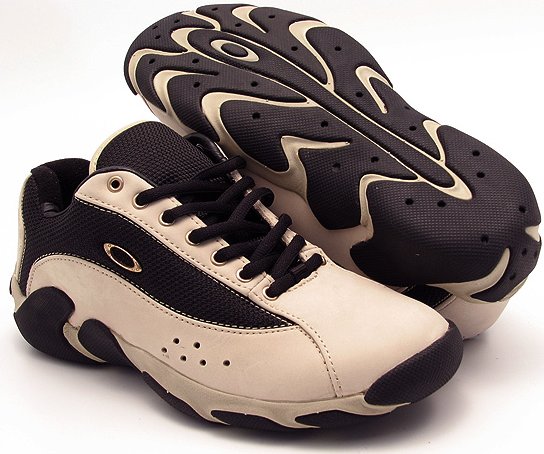
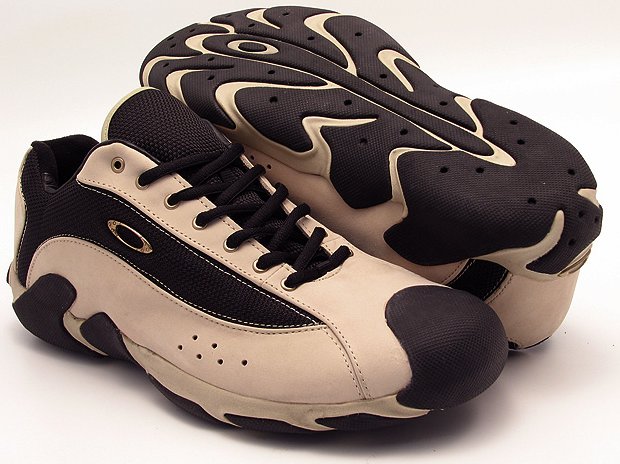
    Simply, these are pretty much the coolest looking shoes ever. Oakley made them in a wide variety of colorways, and even had two varieties of the shoe going at once. Twitch sneakers are generally either designated as either normal (no special label, just “Twitch”) or “Noseless” (also called “Twitch NL”) which refers to the bumper on the, well, nose (actually called “toebox”) of the sneaker, which, to 2006 Dan, had very little functional purpose, but, to 2011 Dan, has shown to be invaluable for avoiding scuffing at this very sensitive area on the versions with smooth leather or suede instead of rough suede. with little functional purpose (other than to avoid some scuffing) . But function or not, it does add a curious aesthetic detail that brings the visual area of the rubber into the leather body of the shoe. This visual melding of two different functional aspects of the shoe (body and outsole) is rare in non-specialized sports shoes/sneakers. [2011 note: I sounded awfully confident in this absolutely made-up “fact”] “NL” versions of the sneaker look a bit more “serious” as there is nothing eye-catching about the toe-box when it’s plain leather. Also, if I consider my online pursuit of the sneakers to be formal research, the “Nosed”/Normal varieties are decidedly rarer than the NL variants. I’m not sure why it’s “Lip” and “Noseless” instead of “Nose” and “Noseless,” but being that the internet is my primary source for this, there’s plenty of room for it to be all wrong. I’m basing this on searching for the shoes from 2004-2007 on the secondary market, as production stopped in 2003 (I think), then even liquidators’ supplies dried up by 2007 or so. The last pair I bought was a second instance of the Storm Normal/Nose version [which, coincidentally, I’m wearing as we speak. 2020 note: this link is dead, and I have no idea what picture should be showing up here]

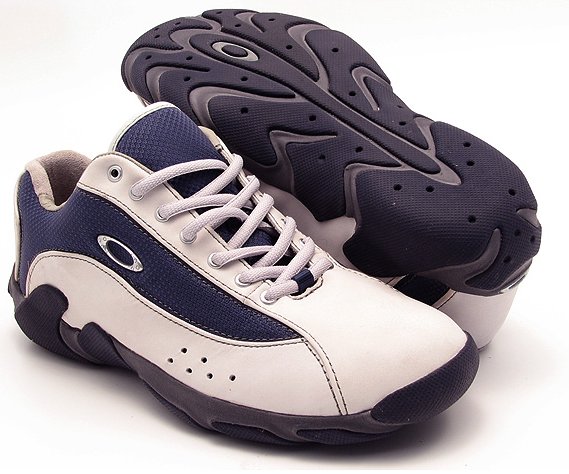
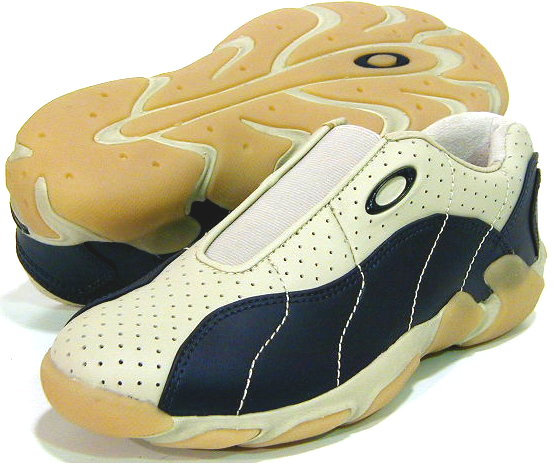
    A tour of the shoe: the outsole has an aggressive pattern than looks as if it were constructed by taking numerous pieces of rubber, and arranging them on the sole. What makes the outsole different is that it, like the “lip,” extends onto the medial side and lateral side of the sneaker, again visually mixing different functional parts of the sneaker. It looks aggressive without the “my sneaker can beat up your sneaker” look of some sports shoes. As the previous pictures have shown, the upper of the shoe isn’t over-the-top, but it’s still eye-catching.

    Onto the colorways:
    First and foremost, I’ll say that I prefer the Normal/”Nose” variety, but being that those are tough to even find pictures online, I won’t make a distinction. I’ll start with the three pairs that I own (most of these pictures were found online, not taken by me. You’ll definitely be able to tell which ones are of shoes I own/have worn.).

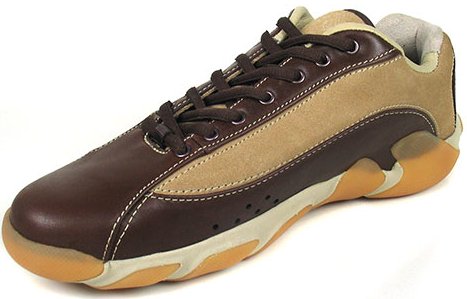
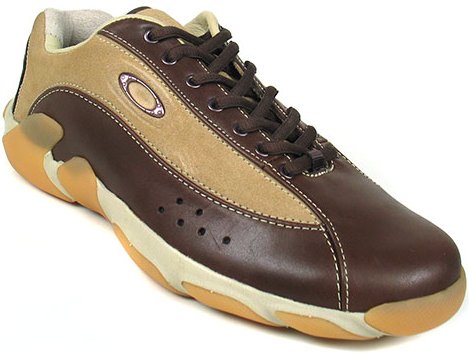
    • Brown/Tan — the first colorway that I saw. Probably could be worn somewhere where sneakers are a faux pas. Light-colored rubber with white mid-sole.
    • Storm (Blue, Light Blue, Blue is rough suede, light blue is smooth suede) — first pair purchased. This colorway lends itself a “sporty” but not particularly “athletic” look. Light-colored rubber with white mid-sole.
    • Tan/Honey (both leather) — Second pair purchased (as of today [2006], haven’t yet made the yearly sneaker rotation). More “serious” looking. Black rubber with black mid-sole (exclusive to this colorway). Frequently found at Overstock.com. I don’t think this colorway is available with the nose/lip. These shoes got beat up especially quickly because of the tenderness of the leather and lack of the rubber nose.
    • Dark Brown (Brown/Light Brown*leather/suede) — Third pair purchased; at least one year away from becoming rotated in. “serious” looking. Almost “dressy.” Brown rubber with brown mid-sole. I do not believe this colorway exists in a nose/lip variety. 2011 comment: I wear these very rarely because the leather is so sensitive to scratches.
    • Oatmeal (Black and Off-white) — Sort of silly looking. Relatively common on ebay [in 2006]. Black rubber with white mid-sole. With the nose they look a bit less silly; I found a pair with the nose on eBay for the right price.
    • Ocean (Navy Blue/Light Blue) — Good mix of colors. Sometimes found in random sizes through Froogle.com [2011: remember Froogle?!]. Black rubber with gray mid-sole. I do not believe this colorway can be had with the nose.
    • Cement/Navy (White/Navy) — Most “athletic” looking of all colorways. Almost looks like a cross-trainer type sneaker. Only able to find one picture in the billions of pages Google indexes. Some have shown up on eBay and I’ve found more pictures. Dark blue rubber with gray mid-sole (blue rubber exclusive to this colorway). Here’s one without the nose.
    • Red/Tan — bright “casual” look. Frequently on eBay (but never in the right size. Brown rubber with tan mid-sole. I’ve never seen this colorway with the nose.

    Well, I think that might be the most thorough discussion of that topic since the design of the shoe within Oakley.
    *****

    The Oakley Twitch receives 5 big stars for being impossibly cool-looking and all sorts of comfortable as well. Sure, some of the colorways aren’t that appealing (I’m looking at you, “Oatmeal”), but the successful varieties create a sneaker that doesn’t look out of place at events where sneakers aren’t normally allowed. The fact that Oakley discontinued the sneaker doesn’t help or harm its rating; I’m sure that if the designer were to have things his or her way, it’d still be widely available. Really, if you come across a pair of size 13US Oakley Twitch sneakers, buy them, no matter what color they are. I’ll pay you back. (Um, if anyone actually takes me up on this offer, let’s set a limit of $50 for the sneakers.) The Coil Over, Flinch, and Coil are similar in design to the Twitch, and being that the Coil Over is my current sneaker (its year is up in April), I can assure you that it’s not the same.

  • When Your Reach Exceeds Your Grasp (aka “The Husky’s Bite”)

    For those unfamiliar, please peruse this PDF of the first (and only) issue of the publication in question. Feel free to right-click and “save as” on that file so that you end up reading both it and my review. If you’ve used the internet before, you probably already have Adobe Reader installed, but if you don’t, you’ll need to download it here.

    The year was 1999. It was sometime in early Winter. It was also just about the end of the “good old days,” and arguably, our little foray into journalism accompanied the starting of what are now known as “the bad old days.” Similar to what kicked off this very site, I (and the “others”) were feeling very opinionated and somehow disenfranchised for disenfranchisement’s sake. We were fed up with our high school’s policies and felt like we were getting the short end of the stick. We also had free time. Lots of free time.

    banner

    Don’t we all. click the image for a picture of the whole first page (it’s the same as the first page in the pdf)

    Being that we have now conquered all media (similar to the “King of all Media,” Howard Stern), it’s important to remember that there was a time when the only conquered medium had been VHS tape. And by conquered, I mean “Let’s write a review entitled, ’13 and Oblivious: The 8th Grade To Kill a Mockingbird Video’.” Anyway, 1999. I said, “Why don’t we make an underground newspaper?” Yeah, no one’s done that gem of teenaged rebellion before.

    We rounded up a crack team of writers and gave them free reign on topics. As always, the topics seemed wonderfully, well, topical for the time, but needless to say, they haven’t aged well and bare a striking resemblance to the articles found in any “underground” high school newsletter. Topics ranged from complaining about the (then new) ID policy, complaining about the prospects of having to do a High School Graduation project (that’s basically just what it sounds like), complaining about the cafeteria foods (way to go, me. very original), complaining about obnoxious teachers/security guards on “lunch duty,” and finally one senior student complaining about his fellow gifted/honors classmates.

    As you can see, none of these are pressing issues; in fact most none of them are particularly, well, anything. The issue would be that we really thought we were getting something done. As if the principal would read it, and say, “ahh, so that’s the pulse of the students.” In fact, we thought it/we would be/were so important that we devised pseudonyms, for, you know, “just in case.” Hindsight makes it obvious that not only were our points of contention of the “tough sh*t” category, some were just complaining for the sake of complaining, any remaining legitimacy lost due to the “editor in chief’s” name being Jarvis P. Fundlebottom. My (er, Jarvis’) take on school lunches is probably the worst offender if only because it’s a topic that’s been beaten to death since the invention of the tray/plate combo. What makes it worse is that I wrote pretty much the same article when I was in 5th grade, except in 5th grade I didn’t bring up Chaos Theory incorrectly (read the article in the PDF to see me butcher Jurassic Park).

    Little of the “expected” controversy manifested itself with the “publishing” and distribution: keeping in mind that we used fake names (though we were so proud of our accomplishment that we gladly told everyone and anyone, teacher or student, of our involvement, usually at great detail) and, again, to anyone that would care about what we thought was “controversial,” what we wrote about was simply inconsequential. BUT, what did cause some controversy (according to the word on the 1999 street) was the opening article, titled, “Skip the IQ Test, We’re All Dumb Anyway.” Ian Cofre (under the “Spike Spiegel” alias) wrote the article, but I’ll very much take credit for the headline.

    Now, at the time (and in very different way, now) comparing the intelligence of the student body to that of a fictional canine boarding school in Wisconsin was hilarious. I’d hate to think of myself as being “politically correct,” but I would think twice about “publishing” something with all of my accumulated maturity. I don’t mean to speak for Ian (and I’m sure that he hasn’t put much thought to it since then– heck I only re-read the whole issue because I recently re-discovered it on one of my backup CD-Rs), but I’d assume that he (or anyone, really) might think twice about the content. In his article, aside from the references to the MCOS (Milwaukee Canine Obedience School), he very much and very directly called out his classmates. Granted he was probably right, but (again, 1999 word on the street), it didn’t go over well with said classmates. Obviously it’s beyond water over the bridge for everyone at this point, and even then, it probably wasn’t a big deal. The significance is that as sort of “editor” of the whole thing, I didn’t think twice about why that might not be the best sort of thing to include in a “publication” we really thought was going to “make a difference.” I didn’t even think in terms of “most of our articles our less than five paragraphs; that doesn’t sound like in depth, hard-hitting commentary.”

    Nate, as “Martin Stephenson,” wrote two features, one of which detailed the (then new) graduation project process and actually did contain some disturbing facts about how different school districts and even schools within districts interpreted the “state-wide” guidelines differently. Nothing wrong with including that article, but it’s just funny that back then, we really thought it would affect something. Now we look at it and say, “of course it didn’t, why would it?” but they call it hindsight for a reason. In classic move common to inconsequential journalism, his second article about cafeteria “issues” managed to highlight the supposed unfairness in having students and teachers follow different codes of conduct (namely: a student yells, he gets in trouble; a teacher makes a lot of noise, no big deal). Again (more of that “hindsight” stuff), of course this is the case, but back then, we thought we wouldn’t stand for it. No, I’m not calling out the Junior Staff’s article; if I remember correctly, we had jointly brainstormed ideas for that article, and I definitely didn’t see any issue in that very immature/uneducated/etc. line of thinking; maybe it was even my (bad) idea, and I’d think that Nate would agree that the “angle” of the story was merely a product of being a subjugate in an high school environment.

    Wrapping up the articles discussion, Josh Shaffer (spelling?) wrote a well-organized, very coherent (click on the link on his name to understand why I’m including that adjective) take on having to wear ID’s while in school that pretty much covered all of the issues, and showed how ridiculous and reactionary the policy was. Naturally, my 10th grade self decided that was by far the most boring of the articles, while it would be the first one I’d hand to someone if I said I was involved in an “underground newspaper” in high school.

    The first issue of The Husky’s Bite was also the last issue though we promised future issues and even future years of it by including not only “issue number” but “volume” on the header. The last page of the issue included a call for submissions, which generated one actual article the very same day we distributed copies and one promise of an article about the Jr. ROTC program. Needless to say, the publishing of something about Jr. ROTC probably wouldn’t have been a good idea (and we were never given an article anyway), and the first/only article submitted was a vulgarity-filled and particularly detailed rant about how all the cheerleaders were sluts. Needless to say, the author (hey, we respect our promise of anonymity!) had been wronged (in his opinion) recently by his cheerleader (ex)girlfriend. I can’t remember the details of the letter, but I do think it included this gem: “All [the cheerleaders] are good at is spreading there [sic] legs and yelling ‘Yeah!’” No, that wasn’t going to make it into issue two.

    Of course, there was no issue two. Not long after distributing the copies of the first issue and the “buzz” had left, we realized that we were basically just looking for something to complain about, and we hit pretty much all of the big, non-complicated, non-nuanced ones in that first issue. I don’t remember if we even got to the point of discussing details of what would be in the second one after we realized we didn’t have anything easy to complain about anymore and recognized how much work putting together an issue was. Sure, a lot of that work was waiting for the “writers” to be done writing their articles, but having been tasked to put the issue together, that was a “not wanting to have to do this again” amount of work. Not that it’s the most demanding program in the world, especially in its Office 97 form, but I learned to use Microsoft Publisher while I was laying out the issue, and as we’ve learned, some companies don’t like to hear that you’ve learned to use a program by teaching yourself as you’ve worked on a project. Making the charts (well, chart), headlines, etc. all took considerable effort (check out the barfing stick figure on page 3!), so made me understand that future issues would not be released in any short, regular length of time.

    **

    When Your Reach Exceeds Your Grasp (aka “The Husky’s Bite“) receives two stars due to the ridiculousness of the content that made it into the debut issue: whether the use of pseudonyms, general concept of the articles, or the “just plain dumb in hindsight” highfalutin attitude we had about it. (To be fair, we got past that within a school week or two of distributing it.) Much of my current opinion on the newsletter can be attributed to hindsight, but that doesn’t mean it’s unfair. Part of the whole “reach exceeding your grasp” thing is that you don’t realize it until after the fact. With that in mind, the font selection is uninspired (there’s an obscene number of different fonts throughout it). When I couldn’t figure out formatting, I just let it go. Check out the sexy horizontal rules that just plain cover-up some lines. All that isn’t to say that we didn’t finish it or that we didn’t have some measure of fun while doing it. It’s what we use as our “newspaper example” when we call ourselves “Kings of All Media.” Simply, it was once. It was fun. It was done.

  • Football (in general) pt.2

    In response to my own review about football…

    As quickly as games get more interesting, they can just as easily slow baaaaaacckkk doooowwn. Hopefully the end will pick up a little bit.

    **

    There are 52 seconds left, and it just seems like the Seahawks aren’t going to get it done. When the end seems so obvious, it gets hard to watch.

  • Football (in general)

    The Seahawks just scored a touchdown+extra point, and the score is now 14-10 Steelers. When it was 14-3 (only one score difference), and the Steelers were driving at the Seahawks’ 10 yard line, it wasn’t even an interesting game. All it took to turn around was one interception and the ensuing touchdown. Baseball, soccer, you name it can’t offer such a quick turnaround from “boring game” into “compelling television” after such a quick momentum change.

    We’ll see how it ends, but right now, this is why as soon as the Super Bowl is over, football fans start counting down the months, then weeks, then days until training camp opens.

    ****½

    (minus 1/2 star for having to sit through commercial breaks, though I’ll admit that they add to the “drama” of the whole event.)

  • The Half-Time Show

    Similar to Nate’s review of Tom Brady’s coin toss, this one writes itself. If you like the Rolling Stones, it was great. If not…well, it was the Rolling Stones. I recognize the difficulty in picking a half-time show that appeals to everyone, and obviously in light of that difficulty, whoever is in charge of the picking them doesn’t worry about appealing to everyone.

    Well, I guess maybe my equally old (to the performers) parents liked the Rolling Stones. Maybe.

    **½

    I’m not sure I’d like any of what their choices could have been (or would have been), so I can’t hold my opinions against them too much. But Michael Jackson in 1993 rocked my world.

  • The Pittsburgh Steelers’ Trick Plays

    Each game, the Steelers come in with eight trick plays. These include end-arounds, halfback options, double-reverses, etc. In the middle of the second quarter, they used their first with great success.

    Lining up in the I formation, one of the most flexible of the offensive formations, Ben Roethlisberger, faked the handoff to the half-back who then ran to the right side of the offensive line as the fullback ran to the left all while a wide receiver from the right side ran towards the half-back. The wide receiver got the hand off, followed the fullback’s blocks to the left and got the easy first down.

    Unfortunately for the Steelers, the drive ended in an interception.

    ****

    The trick play doesn’t receive five stars if only because it didn’t result in a huge gain, just a first down.

  • The Diet Pepsi Commercials

    Without being disgusting, I can’t imagine that “Brown and Bubbly” is the best tagline for well, anything.

    I’ll leave it at that.

    *

    One star, if only because part of marketing is getting “the people” to talk about it in any capacity.

  • Food (supplied by Primo)

    Mmm…. mozzarella, prosciutto, and other Italian words I probably can’t spell very well. The Suprimo and Turkey Diablo.

    primo.jpg

    Best sandwiches ever. 1/2 star off for a necessary lack of variety.

    ****½

  • The Steelers Offensive Line’s Lack of Discipline

    One drive, two false starts at the right end of the Steelers’ “O” Line. That’s the sort of thing that makes it so in the 3rd quarter, the commentators say, “The penalties are killing the Steelers.”

    We’ll see.