Empty Bookshelf Reviews

telling you what to think since aught-five.

Archive for the ‘The Past’ Category

The Muppets

By Nate on November 22nd, 2011

one comment

The Muppets have always been a big inspiration to me. I grew up watching reruns of The Muppet Show, the 9 episodes of The Jim Henson Hour that aired before it was cancelled, the movies, Muppet Babies, Fraggle Rock, Sesame Street and countless other productions. Muppet Christmas Carol is one of my favorite movies ever, and a yearly staple, as is the classic “A Christmas Together” album with John Denver.

This special that was made for The Jim Henson hour but didn’t air until much later on Nickelodeon was one of the first “behind-the-scenes” videos (now a ubiquitous DVD feature) of any kind I had ever seen, and I found it endlessly fascinating. I watched it every time that I came across it on TV. I might venture to say that it has had a profound impact on where my life has taken me.

I’ve taken puppeteering and puppet-building classes, walked around the Muppet Studio in L.A., briefly met some of the current puppeteers, and last year got to make a piece of puppet magic myself.

‘The Muppets’ seems to have stolen our puppet mount-cam idea without either us or them knowing it.

But enough about me. The reason that I’m throwing this out there is that there are other people out there like me. I would venture to say that I’m at the tail end of this multi-generational fascination with these characters. The last great piece of entertainment produced with Kermit, Fozzie, etc., was Chrismas Carol in 1992, nearly 20 years ago.

The Muppets have languished in the years since then, through various changes in ownership and stewardship. There have been two mediocre theatrical movies (the last one still a lengthy 12 years ago), a failed TV variety show, a Christmas special that had its moments, another horrific Christmas special, and the terrible Wizard of Oz adaptation.

This lengthy period of brand failure is exactly what the new movie is commenting on, and it does so in such a marvelous way that all cause for concern about how it treats the franchise’s history should be thrown out the window.

Briefly, the movie’s about a two superfans (Jason Segel and Walter, a new muppet performed fantastically by Peter Linz) who travel from Smalltown, USA to L.A. with Segel’s character’s girlfriend (Amy Adams) and visit the Muppet studios, finding it decrepit and more-or-less closed. Walter finds out that an evil corporation has taken control over the studio, theatre and Muppets name and plans to run all of them into the ground. It’s up to the three of them to get everyone back together to save the Muppets legacy. To say that this bears some resemblance to the current state of affairs with the company is quite the understatement.

I watched the original Muppet Movie the night before seeing this, and I’d recommend you do the same. In addition to being able to recognize a few callback references to the original movie, rewatching “The Muppet Movie” puts things in the new film in such an interesting mindset. Kermit was once an idealistic leader, inspiring friends to uproot their lives and travel to Hollywood to become “rich and famous”. Now though, all these years later, Kermit has become sort of an out-of-touch recluse, living in a mansion with only his 1980s robot butler to keep him company. Any object that could remind him of the past, and the never-detailed, but often inferred event that caused them all to split up, is draped off. (As a side note, I would love to see this dark chapter in the Muppets history. It would be the most depressing scene ever — even more than this and the [i'm not kidding] attempted suicide scene that came immediately before it, which I can’t find now — but it would be so compelling. Side side note: this is the world where Kermit was never born.) He’s not cynical or bitter — Kermit could never be that — but he’s deeply saddened by how much he believes he let everyone down, which is a burden he’s put on himself since the first movie. Now, years after the split, he views his life’s work as a failure and sees getting everyone together as a fool’s errand, but is talked into it.

The rest of the movie parallels the original’s structure, in the “getting the band back together” sense, but it’s almost a flipped perspective. Instead of it being about the hope of becoming entertainers and being able to make people happy, it’s about the notion of losing your friends to infighting, and your legacy to years of inactivity and a company bent on ruining your name and replacing you with other people/characters. While Walter brings new energy and hopeful naivety, the rest of the Muppets seem like old souls. They’ve aged in spirit and seem a little weary. Fozzy looks a little grey. Everyone else has moved on with their lives, and it’s quite the effectively sad portion of the movie.

But the movie is greatly funny. The music is mostly fantastic, especially if you like Flight of the Conchords, whose Bret McKenzie wrote four original songs (and a reprise), and served as Music Supervisor. I didn’t really care for the Amy Adams/Miss Piggy splitscreen duet, but the Jason Segel/Walter duet, “Man or Muppet” is both catchy and hilarious. The direction (by “Conchords” TV show co-creator and director) is great, with extremely minimal CG work and many, many “How’d they do that?” moments. Segel and Adams are cute and bring great likeable human energy, even if their story feels a bit too much in the forefront.

The Muppet performers don’t seem to miss a beat at all. Considering the only original performer still involved is Gonzo originator Dave Goelz, it’s amazing that all of these characters can still “live” and “breathe” when being performed by other people. It has taken me a number of years to get used to Steve Whitmire’s slightly higher-pitched Kermit, but the range of emotion he was able to wring out of that puppet was remarkable. Eric Jacobson (Fozzy, Piggy, Animal, Sam Eagle) and Bill Barretta (Rowlf, Dr. Teeth, Bobo, Pepe, Swedish Chef) are incredible apers of the original Frank Oz and Henson voices and master puppeteers to boot. There is really no difference in the Muppet characters noticeable enough to be a distraction, as in some past productions.

The woman sitting in front of me at the screening and her hippie husband left the theatre complaining about the “Disneyfication” of the franchise. Granted, she was also complaining prior to the movie about bottled water being a scam, but she does have a valid point about the movie, to a limited extent. Yes, everything is slick, polished, and sanitized. There are overhead shots of the Muppet Theatre (Disney’s Hollywood Boulevard El Capitan Theatre repurposed for the exteriors) that show a “Cars 2” billboard prominently in the background. The three new principal roles (Segel’s “Gary”, Adams’ “Mary”, and Walter) do get a little bit too much focus.

But here is why all of those complaints are wrong. Every joke or type of joke in this movie that seemed out of place actually had a precedent set for it in some prior movie or project: breaking the fourth wall, presenting a popular song in a ridiculous way (the muppet show did this every week), the over-top bad guy bent on bringing them down (Chris Cooper, doing a great job in limited screentime), even the ridiculous method by which they travel long distances.

No matter what Frank Oz says, I don’t feel that the characters were ever disrespected, with one possible exception, which I’ll get to later. In fact, I’d say the opposite. The newer characters were either never used (Clifford, Johnny Fiama and Sal Manella were completely absent), or, like Pepe, were pushed to the background entirely. Even lesser-known, older characters like Uncle Deadly, and Wayne and Wanda make appearances.

Oz points to the ubiquitous “fart shoes” joke in the ads as something Fozzie would never do, but in the context of the movie, I think it works. The characters are out of touch and desperate to figure out what people want, and I don’t think Fozzie is below pandering for a laugh. I’d say this movie is truer to the characters than the “World Where Kermit was Never Born” business.

Gary, Mary, and Walter serve as an audience proxy for younger people unfamiliar with “The Muppet Show”. And without Segel’s Gary and Walter there is no real impetus for the characters to reconcile at all, in a not-so-subtle parallel to real-life. Walter and Gary’s storylines are also so simple that they work without being too off-putting, and they’ve found great ways to parallel other character’s stories (the two duets for example).

For me though, and this comes as a side-note, and probably just a personal gripe, but considering he’s the only original performer left, Dave Goelz didn’t have much for Gonzo to do.

I know the last movie, way back when, focused on him entirely, but in re-watching material recently, I’ve realized the hidden layer of soul and sadness that Gonzo can bring, that few others have. The emotion that comes across in this song…

… is something that Miss Piggy and Fozzy are never tasked with. Most of the other characters are just one dimensional, though Rowlf has on occasion brought the emotion in his Muppet Show performances. Because of this, Kermit is left to carry that burden, but his sadness comes from his failures to live up to his ridiculously high expectations of himself as the leader and guy who manages these ridiculous personalities. Gonzo’s pathos has always stemmed from not fitting in, being weird, and not knowing exactly what he is.

Since these characteristics are basically the entirety of Walter’s personality, and his character arc, this brooding side of Gonzo gets pushed to the backburner, and even his comical side does as well. I’d be interested to see his number of lines compared to other characters. I get that not everyone can be properly serviced, but as a member of what I consider to be the core four characters, he feels like an afterthought. You can sense the regret in Fozzie and Piggy, but Gonzo has just seemed to move on. And this overlooking of him is even sadder considering Goelz is the longest-tenured performer here.

I have some mixed feelings about the end, but I have to talk about it in vague ideas. Basically, I feel like it glosses over a majorly important plot point, but the way in which it does this seems to render it fairly unimportant in the overall scheme of things. It sort of takes their literal goal and says their figurative one is more important, which is a great idea, but leaves the main plot as almost a side story.

On the whole though, I felt every emotion I was supposed to, including my normal disinterest in Miss Piggy. I welled up a few times, laughed a lot, and left with a smile on my face, and no feelings of contempt in my heart. I never once thought that they ruined a good thing here, and that’s all I could ask for.

The crux of this movie is whether or not The Muppets are a viable entertainment in today’s pop culture landscape, and I’d say that with the right material (and this is great material… mostly fleece and foam… wocka, wocka), they can be. Let’s hope that the kids that are getting their first taste of these characters feel the same way.

****½

Drive

By Nate on October 4th, 2011

one comment

"Drive" : a new scent for men. From Calvin Klein

How far can you take the idea of creating a nondescript character before you have one that is boring and unlikeable? That’s the argument that’s running through my head as I write about the new Ryan Gosling vehicle (literally), “Drive”.

“Drive” is the story of a mechanic/Hollywood stunt driver/robbery wheelman, who operates under a strict set of rules, like “The Transporter” from “The Transporter”… except without all the parkour/judo/kickboxing, gravity-defying ludicrous automotive action, over-the-top bad music, tied-up Asian people, and shirtless oil wrestling. He shows up someplace at a given time, for five minutes. “If something happens in that five minutes”, he drives them away to safety, if not, he leaves. This is all set up in a pretty brilliant opening, but all of that promise and cool, retro, James Dean withdrawn charisma start to fade away the further we get into the film.

The unnamed driver (more on this later) goes about his business, doing a Hollywood stunt or two, working at Bryan Cranston’s garage, and meeting a doe-eyed neighbor, Carey Mulligan, and her son. He bonds with them, and Cranston tries to get him set up as a racecar driver with a two mob-tied investors (Albert Brooks and Ron Perlman). And through all of this, Gosling’s driver fails to do three things: drive a getaway car in another heist, talk, and show any discernible characteristics aside from being quietly trustworthy (if it were any other guy, I’m sure it would come off as creepy stalking and not stoicism). Yes, the unnamed Driver probably has the least amount of dialogue of any action movie hero I’ve ever seen. But that’s the point. The movie’s overt 80s motifs (most prominently, title font and score) point towards this being a deconstruction of the talky, quippy action movies of that era and their stars (Bruce Willis and Arnold mostly).

But as much as the promotional materials want to portray this as an action movie (to the point where some woman is suing over false impressions from the ad campaign), it is anything but, aside from the beginning and one fantastic sequence in the middle. The movie plays more like a Michael Mann, slow-burn film where the tension comes from characters who have made poor choices facing inescapable decisions that result in violence. Lots of violence.

It’s not that the movie has a crazy-high, cartoonish body count like something like “Commando“; it’s more that the movie goes along with this slow-paced character drama that sporadically erupts into single acts of extreme brutality. We’re talking heads getting smashed, shot, and stabbed, with seemingly unnecessary close-ups and a lot of blood. And that’s just some of it. The thing is, all of these incidents come so abruptly and are so brutal, that after such long periods of quiet they prove to be immensely unsettling. And that’s the point. It’s there to show you that violent action movies SHOULD BE unsettling, and we’ve become so desensitized to that. But does that make for enjoyable entertainment? I don’t know.

It’s the exact same problem I have with the main character. Does a non-character make an interesting “hero”? We’re supposed to root for this driver because he’s in a tough position. Because he makes a choice to help this woman, a choice that ends up not only putting him in a rough position, but is the first human thing he has done in the film, and perhaps in his life. See, he doesn’t have a character name. He doesn’t say anything. He lets other people make decisions for him. He’s just a driver. He has no characteristics that make him appealing as a person. He has no backstory. But then he makes a decision. ONE CHOICE. And, judging by the song that plays over the end credits, this makes him not only a “real hero”, but a “real human being”. Take a listen:

Surprisingly, I think I liked the first-half set-up of the movie more. I was enjoying the change of pace of having this understated, sub-textual relationship-building between the two leads. But once everything starts to fall apart, the driver becomes so hellbent on getting out of the mess he’s in that he basically turns into a psychopath. He’s truly frightening. It becomes like rooting for Michael Myers to just kill everyone, and is that something we really want to do? Not only that, but is this movie saying that transforming yourself from someone who doesn’t care about anything into someone who will brutally hunt down and murder people make you a hero and a human? Or is it again subverting that idea about old-school action movies?

**

“Drive” gets two stars for trying something interesting and different with its characters, having some fantastic acting, and two-to-three great sequences. It also includes a main character that is terribly hard to root for, surprisingly small amounts of action scenes (despite the advertising all but promising us “Fast and Furious 6″), and off-putting bits of hyper-brutality. I’m completely stuck in trying to grade this movie, as I love the guts it has in what it’s trying to do, but I can’t truthfully say I had an enjoyable experience. I guess that was the point?

Written by Nate

October 4th, 2011 at 10:12 am

How to Be Uniform Snob: Phillies vs. Braves (1974 Throwbacks)

By Dan on May 15th, 2011

leave a comment

This is crosspost from Crossing Broad.

Quick note: some of the pictures are from Uniwatch’s write-up of last year’s Phillies-Brewers throwback game as well as the excellent “MLB Game Worn Jerseys of the Double Knit Era” by Bill Henderson.

Well then, other than the fact the Phillies got the “L,” that went pretty well, don’t you think? For the second part of their UniTastic series, both the Braves and the Phillies are throwing back to 1974. That’s right, the Powder Blues and whatever disco-tastic getup the Braves rocked back then.

But, what’s that? These teams already threw back to 1974?! Yep. In 2002. Today’s game will look something like this.

I get a lot of questions like this: “How can I be a uniform snob, too?” Thankfully, “turn back the clock” baseball games really offer the best way to let your snob flag fly.

Let me note that this tongue-in-cheek guide is a bit spoiled by the fact that this combination has been seen before, so there’s a good chance it’ll be a repeat of the 2002 game. Of course, that was nine years ago, so maybe it won’t be so cut-and-dry.

  1. Are the players wearing stirrups? Everyone wore them in 1974, few wear them today (or they just wear solid color socks without the sanitaries showing through.)
  2. Are the players wearing the old uniforms in the new style (the extra baggy, extra long pants look of the last ten years)? Note: the answer to this question is almost always “yes,” so make a comment about it not looking “right,” players’ comfort be damned.
  3. Did the teams spring for matching batting helmets? In 2002 the Phillies did, in 2010 they didn’t.
  4. Do the big details match? Traditional belted pants or Sansabelt? Pullover or buttons? (or for the 70s Phillies, zipper?) Are they wearing their normal pants because they’re “close enough” – see the Braves catcher above in Throwback jersey, normal pants.
  5. Are the little details correct? No Majestic logo on the sleeves? No MLB logo on the back of the hats?
  6. Do the tiny details match? Let me lift this quote from the UniWatch Blog (one of the “weekend writers,” Phil Hecken, analyzing the throwbacks worn last year against the Brewers:
    The Phillies, for the most part, got it right. They went with button-down jerseys (so, 1972-3, if we’re talking the period they were representing), but didn’t spring for the retro helmets. OK, it’s a one-off, no big deal. They wore period-correct caps in dark red (almost burgundy). Well done there. It’s tough to tell, but it appears they went with the closed loop logo on the jerseys, more closely approximating the 1987-1988 jersey. Meh. And they elected to go not only with NOB, but they again went with the 1987-88 radially arched nameplates. OK. Not a big deal, to be sure, but how difficult would it have been to get those details correct.
  7. Finally (and unexpectedly, after all the other analysis), how does the match-up, you know, look?

My quick take: It’ll be a fun match-up to watch. The powder blue Phillies uniforms are seen all-around Citizens Bank Park at each game, and they show up every few years in throwback games (and twice in the last two), so we’re a bit accustomed to them. I like the 89-91 away uniforms more (swap grey for powder blue, and the whole thing immediately looks much less “1970s”), but it seems fans prefer the powder blues.

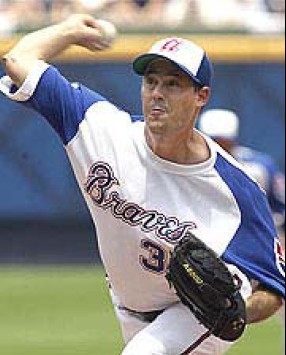
The Braves 1974 uniforms are actually pretty neat – even more “disco-y” than the Phillies, being that they’re made from a template which is out of use. Raglan sleeves still show up, but not with the sleeves in a different color than the body of the jersey. Funky. So, if yesterday’s uniforms were described as “understated” and “classic,” today’s could be defined as “pass the coke.”

For completeness’ sake, let me point out that the 1974 Braves away jersey was the opposite of the home jersey (White sleeves, Blue body). Ahh, the 1970s.

****

It’s always good to see some uniform variety.

Written by Dan

May 15th, 2011 at 3:52 pm

Uniform Analysis: Phillies vs. Braves (Negro League Throwbacks)

By Dan on May 14th, 2011

2 comments

This is crosspost from Crossing Broad.

I usually stick to NFL uniforms and snide remarks in the comments, but the Phillies have a …UniTastic weekend series against the Braves, wearing Negro League throwbacks on Saturday and 1974 throwbacks on Sunday, so here’s a quick run-down and review for Saturday’s game. Some comments about Sunday’s game later.

Unfortunately, I don’t have much background on the Negro Leagues, much less their uniforms, so this is more of a seat-of-the-pants review than anything grounded in facts and history.

That said, on to the uniforms.

6a0120a6dde087970b01538e7b0d13970b

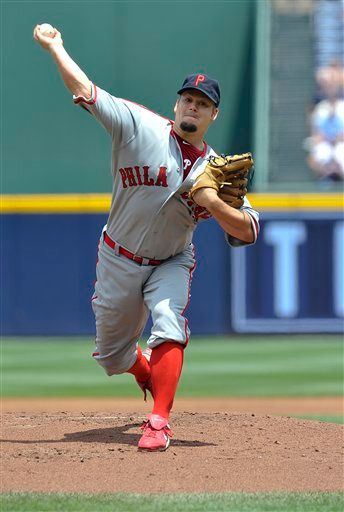
The Phillies are wearing the uniforms of the Philadelphia Stars. You may have seen this logo floating around, but it doesn’t actually appear on the uniform. The uniform itself is plain, but has some nice details beyond just the novelty of them being throwbacks. Example, the old timey typeface of the arched wordmark and the numbers just gives the feeling of “old school uniform,” the simple, thin, and effective, red piping around the neck, connecting to the arm is a timeless feature which makes them look like a sports uniform instead of a shirt. The 1980s Mets and Indians (among other teams) experimented with this look, but the thin stroke does much more with less than the gaudy patches on those uniforms. Black (navy?) stroke around the lettering is a nice touch to increase contrast. The hat logo is extremely plain; it’s better than the Black Crackers hat, but it’s too plain to leave an impression.


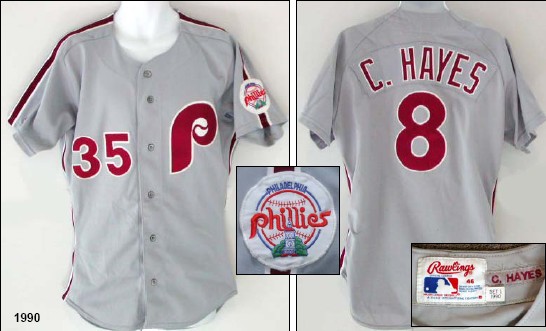
A neat detail is that someone finally realized that “Philadelphia” has way too many letters to comfortably fit on a shirt and maintain readability, so they said “screw it” and abbreviated it to “Phila.” Genius. Really. For another example of the letter-overload hassle check out this prototype from the 1992 Phillies uniform refresh.

833743712_0945e2968a_o
Special Note: The slide detailing the prototype is from the guide “MLB Game Worn Jerseys of the Double-Knit Era” by Bill Henderson (who happens to be from the Philadelphia area). He’s hosting a “Phillies Uniform History” discussion on May 26 in Philadelphia. If you’ve read this far into this entry, consider it a “must attend.”


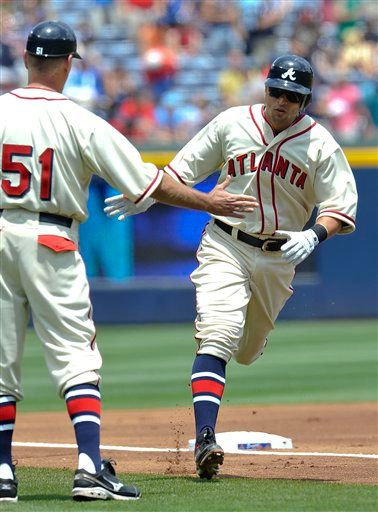
HqshkThe Brave’s Black Crackers uniforms, again, look like “classic” baseball without the old timey feel. It’s interesting to see that the letters and numbers get drop shadows instead of strokes (as drop shadows are generally considered a more modern look). Vertically arching the “ATLANTA” copy (contrast to the horizontal arching on “Phila. Stars”) gives a dynamic look considering it’s just a plain sans serif typeface with a drop-shadow. Unfortunately, the “A” logo, while unique is simply ugly and does not mesh with the typefaces used for the letters and numbers.

Closing out the review of the jersey, the most interesting detail is the piping down the placket is just like what the Braves have used since 1987. (well, maybe not “just like” – I can’t tell if it’s the same dark-red-dark pattern on both the Black Crackers and Braves uniforms because of the limited resolution of the single [thanks MLB!] picture released). The Braves also used this design in the 1930s, per this picture of Babe Ruth.


Finally, I’ll group the pants/socks discussion together. Most uniform aficionados are probably going bonkers (in a good
way) because the league (likely) compelled all player to wear stirrups. The Phillies are wearing solid red (not unlike what you see onOswalt), but the Braves are wearing Navy blue stirrups with spaced White-Red-White stripes. Very cool. BUT, the best part of these uniforms are the off-color pants pocket flaps. We reward attention to detail, and those are awesome.

Fullscreen capture 5142011 15413 PM.bmp

In terms of the game aesthetically, it looks good, but it’s not the most interesting combination if only because both teams are wearing uniforms where the primary color is Red with a dark accent color (either Navy or Black), but part of the appeal of baseball is the unholy number of games in the season, so even if they’re not the most interesting uniforms ever, it’s good to see variety on the Phillies (who have a pretty staid uniform “system”: one home/one away/one alternate) and it’s always good to point out and keep in mind that not all that long ago, the US still saw segregation to the degree that a whole portion of the population was not considered fit for the MLB for no reason other than skin color.


**** Kind of plain, but a good looking baseball game.

Written by Dan

May 14th, 2011 at 8:36 pm

2010 Eagles UniDictions (uniform + predictions) – Week 1 – Packers

By Dan on September 11th, 2010

leave a comment

This has been cross-posted on crossingbroad.com, a great destination for Philadelphia sports news.

Mainweek1

Being that all predictions for the NFL season thus far are based on a combination of  last year’s results and four pre-season games (The NFL Pre-Season — The four weeks when your friends with season tickets slightly regret their purchase!), we might as well base our predictions on something more arbitrary with little bearing on the actual game*.  Uniforms. 

[*I think some coach or player was once quoted as saying "look good, play good," so creative interpretation of the rules of English grammar aside, I'll leave it at "little bearing" instead of "no bearing."] 

 The big news for this game is that the Eagles will be wearing their 1960 throwbacks.  As detailed at great length previously, I don’t like them.  Classic, accurate, but too plain.  The presence of Kelly Green should appease the loud “bring back the Cunningham-era jersey” people who don’t realize that the throwbacks are not the same as the “Cunningham-era” uniforms (white vs. silver paints, Eagle logo on shoulder, stroke around the numbers, helmet wing details, etc.).  So at the minimum, it takes away their ability to complain about the uniforms, giving more time to complain about things that matter.  Like Kevin Kolb.

With the Eagles wearing green jerseys, this puts the Packers in their White Jersey/Yellow Pants combination.  I don’t think it’s the best combination in the NFL (undecided on that one at the moment), but it’s everything the Eagles throwback is….except it’s not boring.  Something as simple as shoulder striping really makes the look of the “classic” NFL uniform template work well (think of the Bears and the Browns).

The UniDiction

Either 2, 3, 6, or 7 points awarded for each category (safety, field goal, touchdown, touchdown+point after, of course)

Helmet

Eagles: 3 — a white (or black) stroke around the wings would really help.  Really, the design looks unfinished.  A plain green helmet, though historically inaccurate, would look better.

Packers: 7 — there’s absolutely nothing I would change

Jersey

Eagles: 2 — Championship aside, this isn’t one of the Eagles’ better looks.  It’s just green with white numbers!

Packers: 6 — missed PAT because their Green jersey + yellow pants combination is one of the defining images of the NFL.

Pants + Socks

Eagles: 6 — the two green stripes on the white pants definitely add something, and the white stripe on the green section of the socks avoids the “endless field of green” effect seen on the jerseys.  That said, one thick vertical stripe would look better on the pants.

Packers: 7 — the contrast-color/white/contrast-color triple stripe on the pants is nice touch, and the two-tone socks (without anything breaking-up the solid color) work because they would look too busy with a stripe, being that there are plenty of stripes elsewhere.

 Intangibles

Eagles: 7 — authenticity counts and the fan base really likes them.

Packers: 6 — Points awarded for using yellow in their color scheme.  Missed PAT due to the management thinking a uniform from an era with completely different equipment would translate to the 21st century.

Final Score

Eagles 18

Packers 26

Hmm… I may need to adjust my scoring system to add up to numbers which look like real “football scores.”  And so it can go above 28… 

Also of interest, UniWatch (Paul Lukas) on Page 2 posted his 2010 overview of all NFL uniform changes yesterday.  Definitely a must read.

****

The match-up itself gets four stars. Both teams will be wearing “classic” uniforms, and both teams’ colors complement each other.

Written by Dan

September 11th, 2010 at 4:32 pm

Eagles 2010 Uniform Round-Up – The 1960 Throwback

By Dan on August 23rd, 2010

leave a comment

This has been cross-posted on Crossing Broad, an up-and-coming Philadelphia Sports destination — heck, they’re the ones who broke the story that Dorney Park was the first rehab assignment for Ryan Howard

Lil’ Shebaz: Patriot, Martyr, Wide Receiver.

It’s that time of year – the notable roster additions and subtractions have been discussed, the expected win-loss record has been decided, the newly featured players have had a chance to step up, and the Cowboys fans have been thoroughly bashed.  What’s left?  Well, three interminable pre-season “games,” and lengthy discussions of uniforms.

We’ll be taking a hard look at the Eagles 2010 uniform situation today, then running a week-by-week season preview showcasing each expected match-up.  (the NFL doesn’t have hard and fast “home” and “away” uniform designations like baseball, so there will be some guessing)

The biggest uniform news this season by far is the addition of the 1960 Kelly Green over White Throwback to be worn for 2 (or 3?) games.  Though most fans (this one included) have generally positive opinions of the current “Midnight Green” uniform sets, others clamor for a return to the Kelly Green, which had been the primary color used from 1948 (or prior?) to 1995.  ”They should wear the Cunningham-era jerseys again” was the typical comment, and I think that most people lump all of the Kelly Green designs together (they look almost the same from the beginning to the last ones in 1995), and, well, the Cunningham “era” is the most convenient point of reference for the “old school” look, if only because the Eagles weren’t a particularly great team during his 1987-1994 run, and the McNabb era is associated with the Midnight Green, though it predates him by three seasons.

Of course, the “reason” (beyond additional merchandise revenue — yes, people even bought the yellow and blue monstrosities from 2007) for the throwbacks is to celebrate the 1960 season, so much of the discussion of “this other Kelly Green design would have been better” is rather moot, but words and opinions are free on the Internet, so here comes the soapbox.  Keep in mind this is not a discussion of the authenticity of the throwbacks or how close they got to the classic look; this is all about the look itself.

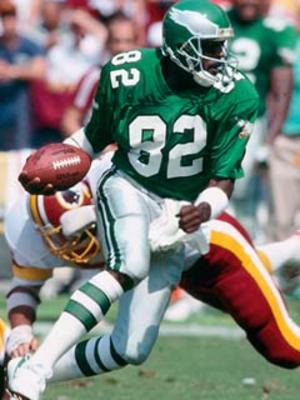
Simply, the 1960 throwbacks are boring.  Not because they’re “old,” not because they’re “classicly simple,” but because they’re brutally plain.  Look at what the Packers and 49ers can do with the “classic” NFL template.  I don’t need the modern busy-ness of the Bengals, the Bills, or the Broncos, but the jersey is literally just green with white front/back numbers and TV numbers (what numbers on the sleeves are called).  No stripes, no trim, no stroke around the numbers, heck no logo (the Reebok logo doesn’t count) or even Eagles wordmark.  Sure, they’re authentic, but they’re boring, too.  [I don't think the current uniforms are perfect either; see my comments in future articles.]  Come to think of it, the vaunted “Cunningham-era” jerseys aren’t all that great either; very, very plain, but at least they added an Eagles logo to the sleeves and black stroke around the numbers (on both the green and white jerseys) adds something to it.

The pants and socks are an improvement, with two green strips along the outseam of the white pants, a white belt, then a ~50/50 ratio of white sanitaries over green socks, with a slim white band on the green socks to visually “break” the verdant field.  (triple word score!).

Unfortunately, in the interest of authenticity, the wing detail on the helmet is plain silver.  It lacks both the simple white stroke of the “Cunningham-era” helmets and the more complicated black and white inner and outer stroke of today’s helmets (which also include an arguably excessive silver highlight color to give more definition to the “feathers”).

Ignoring the significance of the 50th anniversary, what were some other, maybe more visually interesting options?

Well, the 2nd most of thought of (in my incredibly unscientific poll of one) Kelly Green uniforms are those funky ones from 1969-1973 with a white helmet with green wings.  (even funkier in 1973 when they had a black stroke around the green wing).  Then there are those “wasn’t disco bad enough” late 70s-early 80s disasters.  Or as I call them Stripezilla 1 and Stripezilla 2, Stripezilla’s Revenge.  Or, they could’ve done something practically sacrilegious and just replaced Midnight Green on the current uniforms with Kelly Green and swapped in the silver pants of the “Cunningham-era” (file by Jeff Shirley from a uniwatchblog.com uniform tweak round-up).

Look for future articles about uniforms as the season approaches, then a weekly uniform-centric overview of each upcoming game.  Until then, enjoy the Eagles in their white over white combo, a look which is unique to their pre-season games.

**½

The 1960 Eagles Throwback gets two-and-a-half indecisive stars. It’s nice to see the Kelly Green on the field, but it’s definitely not the best version, even if executed exactly.

Written by Dan

August 23rd, 2010 at 7:12 pm